All the evidence shows voters want Labour to shift to the left — but initial signs from Andy Burnham are worrying on that front, cautions DIANE ABBOTT


 Latest editorial
Error message
An error occurred while searching, try again later.Iraq 2.0: Washington’s oil blockade launches assault on Venezuela and Latin America
Trump is gambling with an entire continent, behind the rhetoric of drugs and security lies a dangerous hunt for raw materials and an illegal push for regime change, asserts MARC VANDEPITTE
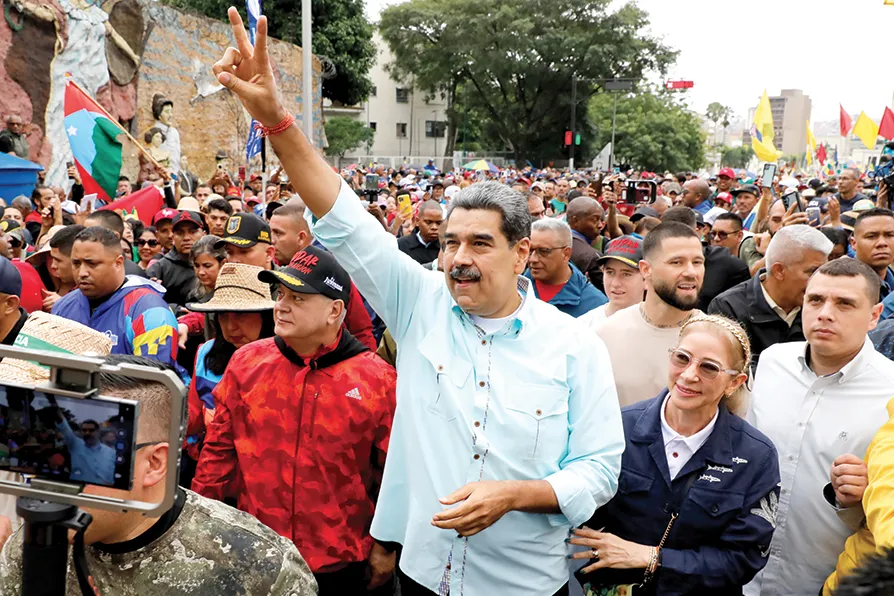 US TARGET: President Nicolas Maduro joins a rally in Caracas, on December 10, to mark the anniversary of the Battle of Santa Ines in 1859, when the progressive forces, led by the Hugo Chavez of the time, general Ezequiel Zamora defeated the oligarchy
ANDY McDONALD MP says Labour must show it is capable of delivering real improvements in people’s lives — bold action is required
ANGUS REID and ANDREW JOHNSTONE report on an initiative that we must take this summer
ALLISON FEWTRELL on what Plaid Cymru's historic election victory means for the communities being failed by Wales’s housing crisis, and four things the new government can do right now
France Insoumise MP JEROME LEGAVRE speaks to Christophe Domec on building the Europe-wide peace movement that came together in the International Conference Against War last weekend
At last weekend’s International Conference Against War, LINDA PENTZ GUNTER talks to the Palestinian physician and politician about the struggles ahead to achieve a truly free Palestine





ON DECEMBER 16, Donald Trump announced “a total and complete blockade” of all sanctioned oil tankers traveling to and from Venezuela.
He claims that Venezuela “stole” oil and other riches from the US and aims to designate the Nicolas Maduro government as a foreign terrorist organisation.
According to Trump, “Venezuela is completely surrounded by the largest armada ever assembled in the history of South America.”
The blockade follows a series of US attacks on ships in the region, officially carried out in the name of the “war on drugs.” However, according to Trump’s chief of staff Susie Wiles this is part of a campaign to topple Maduro.
She stated that Trump “wants to keep on blowing boats up until Maduro cries uncle.” Nearly 100 people have already been killed in these operations.
A familiar scenario
To justify this military aggression, the White House is resorting to a familiar playbook. Trump signed a decree declaring fentanyl a “weapon of mass destruction,” claiming that “America’s adversaries are trafficking it to kill Americans,” despite the fact that it does not originate from Venezuela. As in 2003 with the invasion of Iraq, a supposed security risk is being inflated into an existential threat.
There were no weapons of mass destruction in Iraq, but the invasion did bring decades of chaos and instability. Secretary of State Marco Rubio has also warned that Iran and Hezbollah “have planted their flag on Venezuelan territory,” much like the fabricated stories about al-Qaida and Saddam Hussein years ago.
Other politicians are repeating familiar slogans: that Maduro now poses “an existential threat,” that the war would be “an easy job,” and that it will “transform” the region with “freedom and democracy,” creating a new “beacon of hope.”
The parallels with 2003 are unmistakable: once again, an enemy is demonised, a threat is exaggerated, and war is sold as a quick, liberating operation. Only the names and the map have changed; the script remains the same.
Motives
Washington’s fixation on Venezuela is easy to understand. In the eyes of the White House, the country commits three “cardinal sins”: it possesses the largest oil reserves in the world over which the US has no control, it pursues a sovereign foreign policy with allies such as China, Russia and Iran, and it uses its wealth for social programmes.
Since the election of Hugo Chavez in 1998, the US has attempted to enforce regime change through sanctions, coup attempts, diplomatic pressure and covert operations.
But Venezuela is only the first domino. Cuba, Nicaragua, Mexico, Brazil and Colombia are also being targeted with sanctions, trade threats, election manipulation and orchestrated protests.
This fits into the new so-called “Donroe Doctrine.” Marshall Billingslea, a former staffer under both Bush and Trump, says the ultimate target is the entire Latin American left, “from Cuba to Brazil, Mexico and Nicaragua.”
Former Southern Command chief General Laura Richardson recently admitted openly what this is really about: control over Latin America’s enormous wealth of raw materials — oil, lithium, gold and rare earth metals — as the foundation for Western military and technological power, with Venezuela’s oil reserves as the primary trophy.
The US needs those raw materials to sever its dependence on China and to prepare for a future conflict with the country.
Dramatic consequences
For Venezuela, the consequences of this blockade are dramatic. Oil is the country’s financial lifeline, accounting for at least 95 per cent of all foreign exchange earnings.
Recent US sanctions, including the seizure of an oil tanker, will make it even more difficult to sell crude oil abroad. It is estimated that up to 30 per cent of exports are now in the danger zone as shipowners and buyers withdraw out of fear of US retaliation.
Furthermore, Venezuelan oil production is already more than 70 per cent lower than it was at the end of the 1990s, leaving the country hovering around 21st place globally. The sanctions also scare off allies: even Russia and China will think twice before investing further in the Venezuelan oil sector.
Up to 80 per cent of government revenue risks disappearing, leading to shortages of food, transport and basic goods, with mass migration as a consequence.
Reactions
The Venezuelan government has condemned the blockade as a “grotesque threat” and “international piracy.” Since the war threat began, President Maduro has responded with national defence exercises while simultaneously calling for dialogue. In various parts of the country, civilian militias, police and the army are training to protect infrastructure.
Despite the presence of warships and sanctions, daily life in Venezuela continues largely as usual. In working-class neighbourhoods, people are organising through neighbourhood councils. According to Anais Marques, “both Chavez and now Maduro have always had the support and backing of an organized, mobilised people.” A poll from the end of September shows 65 percent support for Maduro.
Historian Miguel Tinker Salas emphasizes that “Venezuelans are firmly to opposed to a US intervention” and that even opponents of Maduro “will not stand idly by and allow their rights to be subverted.”
In Latin America, social movements, inspired by the Spanish civil war, are preparing internationalist brigades to help defend Venezuela against US aggression.
Within the US, there is significant resistance to both military intervention and the oil blockade because the risks are massive and the gains uncertain. Seventy per cent of the population opposes military intervention.
US citizens are war-weary after Iraq and Afghanistan and do not view Venezuela as a direct threat. Even some Republicans argue that the president cannot start a new conflict without a green light from Congress.
And Europe?
Any other country that issued an illegal oil blockade and committed war crimes would face strong condemnation and likely sanctions from the EU.
At the summit on November 9 between the EU and the countries of Latin America and the Caribbean, the joint declaration stated: “We reiterate our opposition to the threat or use of force and to any action not in accordance with international law and the Charter of the UN.”
These words sound particularly hollow, as there is currently no sign of such “opposition.” Neither commission president Ursula von der Leyen nor Kaja Kallas, the high representative of the union for foreign affairs and security policy, has condemned the US blockade or its military actions.
Germany got no further than having “taken note” of the blockade. Berlin warns that the measure could endanger regional stability and calls on all parties not to take steps that would further fuel tensions. Blah blah blah.
Recently, European leaders have been proclaiming in unison that they want to position themselves independently of Washington and pursue their own course. But when push comes to shove, they repeatedly fall back into the same stubborn subservience.
The aggression against Venezuela is not an isolated incident; it is a dangerous precedent that could drag the entire Latin American continent into a spiral of economic blackmail, war and chaos. Those who remain silent today about the blockade of Caracas legitimise future attacks on Havana, Managua, Bogota or Mexico City.
It is urgent that progressive forces worldwide — trade unions, social movements, parties and intellectuals — organise a broad front against this imperialist war logic.
Resistance against the blockade of Venezuela is more than solidarity with a single country; it is a struggle for peace, sovereignty, and social justice throughout Latin America and beyond.