Latest editorial
Error message
An error occurred while searching, try again later.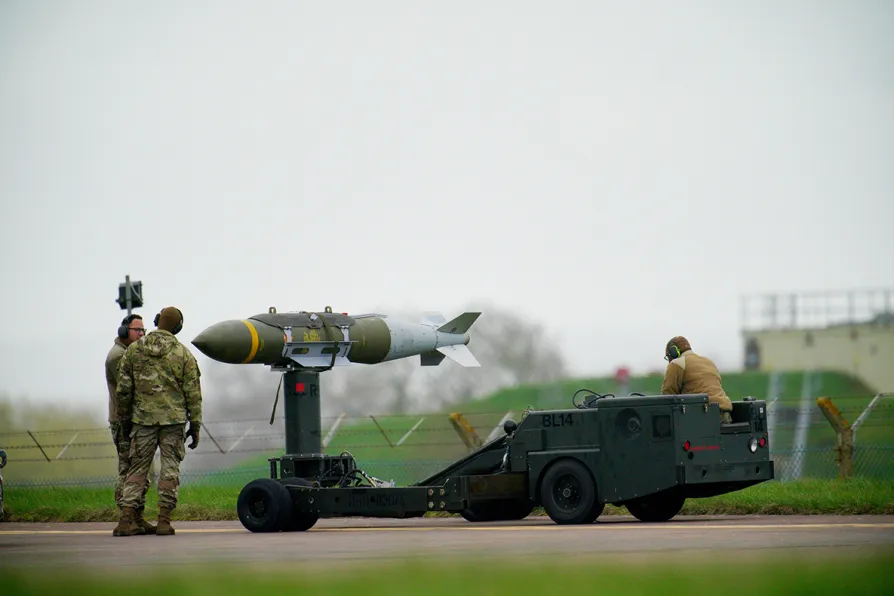 A US Air Force B-1 bomber is loaded with bombs at RAF Fairford in Gloucestershire, March 16, 2026




OUR government is lying about its role in Trump’s war on Iran. As Tehran’s warning to Yvette Cooper shows, it isn’t fooling foreign governments; and as demonstrators will make clear on Saturday at RAF Fairford in Gloucestershire, it isn’t fooling people at home either.
US bombers are on the tarmac there, being loaded with bombs to drop on Iran.
Keir Starmer’s claim that they will only be used for “specific and defensive” activity would be unenforceable even if the concept of “defensive” bombing in a war of aggression begun by the US made sense.
As the Campaign for Nuclear Disarmament notes, in reality the British government cannot control and is probably not even informed of the bombers’ targets.
The first day of the war saw a “double tap” Tomahawk missile strike by the US destroy a school, killing 175 people, most of them schoolgirls. Operation Epic Fury began with an epic war crime.
Names of the dead will be read out at RAF Fairford. But the war crimes have by no means ceased.
The US and Israel have bombed bustling city centres, markets and bazaars. They have blasted apart an oil depot in Tehran, engulfing a city bigger than London in acrid smoke and acid rain.
Now the war has moved to mutual targeting of energy facilities, sending the price of gas soaring. Iran warned it would retaliate in kind if its South Pars gas field was bombed; Israel bombed it anyway, prompting an Iranian attack on the largest liquefied natural gas terminal in the world, Ras Laffan in Qatar. It may be years before the terminal can operate normally again, even if fighting were to stop now: the looming inflationary spiral will not be a blip.
Trump’s war is going to turbo-charge the cost-of-living crisis. Starmer, announcing small-scale measures to assist some specific early victims such as households reliant on heating oil, will have to be forced to go further — much further, in the direction of public ownership, price controls and higher taxes on corporate profits — if the majority in this country are not to feel a lot poorer by the end of the year.
He says repeatedly that the best remedy is de-escalation. This is true, but the British government is not working to de-escalate the conflict. In allowing the US to use our bases to strike Iran it is helping Trump to maximise his firepower: it is facilitating escalation, and it is turning Britain into a target.
Nor is its diplomatic posture conducive to peace. Iran’s determination to impose a high cost on the US and Israel for their aggression is about more than revenge, though starting a war by killing another country’s leader certainly incentivises that.
Iran has been bombed by the US and Israel without provocation two years running, after years in which its diplomats, officers and scientists have been murdered casually by those same rogue states. The now slain General Ali Mohammad Naeini’s remark that the war will end when “the shadow of war is lifted” points to Tehran’s concern to ensure the aggressors pay heavily enough that they do not lightly attack again.
In short, it wants security. Starmer’s brazen hypocrisy, condemning Iranian retaliation while refusing to condemn the attacks which provoke it, provides the opposite: proof that the US’s European allies are too cowardly to stand up to the White House even when the chaos it creates is rocking their economies.
British bases must be closed to US forces.
That would be de-escalation in practice, helping to contain the war. It would atone for our complicity in US war crimes. By limiting the number of sites from which attacks can be launched, it could contribute to the security guarantees that might bring peace a little closer.
For now, we are part of this war. Only by refusing that can we help to end it.