JAYNE FISHER on why the government’s latest amendments to the Crime & Policing Bill, which returns to the Commons on Tuesday, is a serious threat to our freedoms


 Latest editorial
Error message
An error occurred while searching, try again later.
Silent night in Bethlehem: a town of war and occupation
Once the bustling heart of Christian pilgrimage, Bethlehem now faces shuttered hotels, empty streets and a shrinking Christian community, while Israel’s assault on Gaza and the tightening grip of occupation destroy hopes of peace at the birthplace of Christ, writes Father GEOFF BOTTOMS
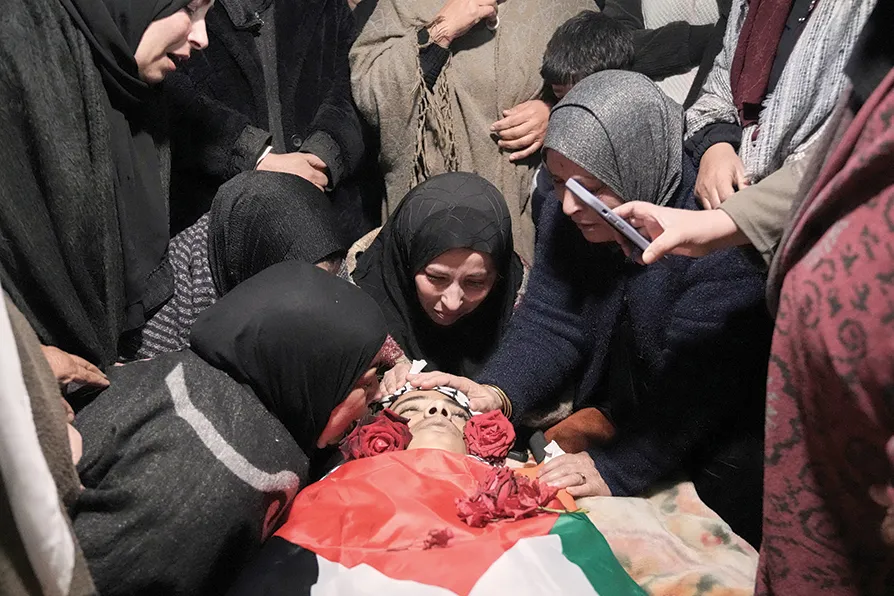 PALESTINIAN PIETA: The mourning over the body of Ammar Sabbah, 16, killed in an Israeli military raid near Bethlehem, December 16 2025
A surge in futures activity minutes before news of US–Iran talks has led to questions about insider trading and oversight gaps, writes CJ ATKINS
In his fortnightly Borderlands column, MARK SEDDON visits overgrown forts along Offa’s Dyke and reflects on wars past and present
With attacks on industry, healthcare and education intensifying, JAMSHID AHMADI warns of a deliberate drive to cripple Iran and calls for urgent global action
The Committee for the Defence of the Iranian People’s Rights (Codir) cautiously welcomes the ceasefire, but remains suspicious of US and Israeli intentions
JOHN McINALLY assesses what we’ve learned from the disastrous US war so far





IF JOSEPH and his expectant wife Mary had visited Bethlehem this Christmas there would have been plenty of room at the inn.
There would have been no need to slum it round the back of a B&B, where the animals were stabled, or to use a feeding trough as a neonatal cot.
Since Israel’s genocidal assault on Gaza since October 7 2023, Bethlehem’s economy, already one of the most vulnerable in the region, has suffered an unprecedented collapse. Tourism, the lifeblood of the city, vanished almost overnight. In the West Bank alone, 1,092 Palestinians have been killed, nearly 11,000 injured, and 21,000 arrested at the hands of the Israel Defence Forces (IDF) and colonial settlers.
As a result there will be a smaller gathering this year to switch on the Christmas lights in Manger Square, and the Midnight Mass at St Catherine’s Church, adjacent to the Basilica of the Nativity, will be a quieter affair.
International dignitaries, diplomats, charities, and pilgrim groups who normally attend will struggle to enter the city.
For decades, Bethlehem’s Christian families have sustained themselves through small hotels, pilgrim restaurants, olive-wood workshops, guided tours and religious handicrafts. These trades are not merely economic enterprises; they are a cultural and spiritual heritage passed down through centuries.
But the events of the last two years have brought nearly all of this to a standstill. Hotels stand dark and empty. Family-run businesses, some of which survived under Ottoman rule, the British mandate, and decades of political turmoil, have shuttered their doors.
Bus drivers, tour guides, cafe owners, youth hostel workers and market traders have been left without income. A Bethlehem businessman described the situation simply: “The city has been paralysed. When pilgrims do not come, our people cannot live.”
The World Health Organisation reported in late 2023 that 40 per cent of Palestinians were surviving on less than $2 a day. Local Catholic charities say this percentage has not improved, and may even have worsened, chronicling rising levels of food insecurity, untreated illness, and growing debts among ordinary families.
The economic crisis is only part of the story. Bethlehem remains enclosed by a network of physical barriers: high concrete walls, military checkpoints, roadblocks, earth mounds and trenches that separate neighbourhoods and isolate the city from Jerusalem and nearby villages.
The separation wall, rising eight metres high in parts, winds through the landscape like a scar, leaving its inhabitants squeezed between 37 Jewish enclaves, where a quarter of all West Bank settlers live. Its presence affects every aspect of life.
Permits are required to travel beyond Bethlehem for work, medical appointments, family visits and religious observance. Many are rejected without explanation. A simple journey, such as a mother taking a child to a specialist hospital in East Jerusalem, can be delayed or denied entirely.
One Irish pilgrim who visited earlier this year said: “Bethlehem is only a few kilometres from Jerusalem, yet it feels like another world. The psychological weight of the wall is immense — you feel it before you even see it.” Local Christians echo this sentiment daily. The barrier has not only altered the physical landscape but has carved deep wounds into the emotional and spiritual life of the city.
Following the six-day war in 1967 Bethlehem has been occupied by Israel together with the whole of the West Bank. In 1995 Israel conceded control of the city to the Palestinian Authority (PA) under the Oslo II Accord in preparation for a two-state solution. While the PA is responsible for the administration and security of the city, Israel controls its borders and much of the surrounding governorate.
While Bethlehem is predominantly Muslim and no longer mainly Christian, it hosts the largest Palestinian Christian community and the two faith communities live peacefully side by side. In fact the city is revered by Muslims, as they regard Jesus as a prophet, and hold his mother Mary in great esteem, and they often join in the Christian celebrations.
In 1950 Arab Christians made up 86 per cent of the population, but now they form less than 10 per cent, yet to preserve the city’s historical Christian character, a special local statute requires the mayor and municipal councillors to be Christians.
Meanwhile the Christian community of Bethlehem continues to shrink at an alarming rate. Economic hardship, lack of opportunity, and the suffocating effects of restrictions have pushed many young Christian families to emigrate abroad in search of stability. The churches of Bethlehem, especially the Catholic and Orthodox parishes, speak with sorrow about the “slow bleeding” of the community.
As younger generations leave, the population left behind grows older, more fragile and more dependent on charity
Yet there is an extraordinary resilience among those who remain. They speak of their presence in Bethlehem not merely as residence but as vocation. As one local parishioner put it: “We are the descendants of the first believers. If we leave, who will keep the light burning at the place where Jesus was born?”
Despite economic devastation, restricted movement, and isolation, faith endures in Bethlehem.
So as Bethlehem steps cautiously back towards a festive season, the need remains immense, especially as the present ceasefire in Gaza (violated by Israel in its drive towards ethnic cleansing) approaches the second phase, and President Trump’s imperialist “peace plan” amounts to an open-ended foreign military occupation.
This Christmas, we are called not only to remember Bethlehem but to stand with Bethlehem: with its families, its elderly, its sick, its struggling young people, and especially with those who suffer in silence. We are called to stand in solidarity with all Palestinians in their struggle for liberation and an end to Israeli occupation.
One Bethlehem priest expressed the paradox of this holy season with painful clarity: “The Prince of Peace was born here, but peace has not been born here yet. This Christmas, the dove of peace still needs to wear a bulletproof vest.”