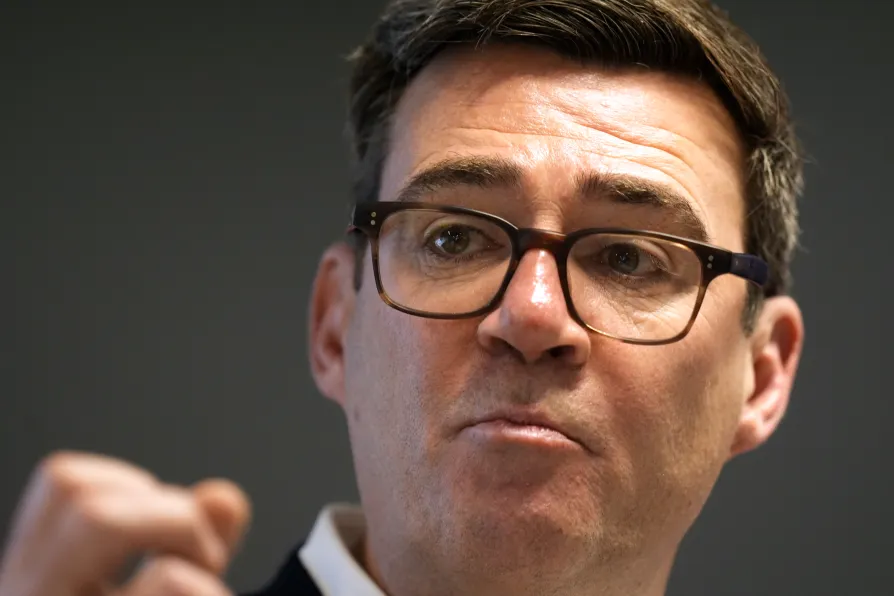
All the evidence shows voters want Labour to shift to the left — but initial signs from Andy Burnham are worrying on that front, cautions DIANE ABBOTT


 Latest editorial
Error message
An error occurred while searching, try again later.‘Cuba’s revolution does not collapse with the wind. It is rooted in the soul of our homeland’
FIDEL ANTONIO CASTRO SMIRNOV, grandson of the Cuban revolutionary leader, speaks to Morning Star editor Ben Chacko about his country’s resilience in the face of dire threats, its incredible achievements and the legacy of his grandfather
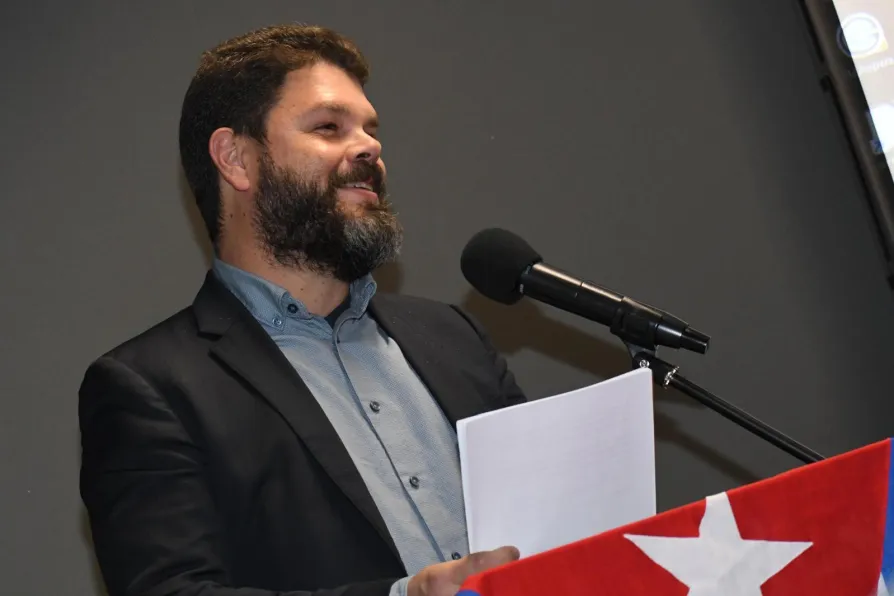 Fidel Antonio Castro Smirnov
ANDY McDONALD MP says Labour must show it is capable of delivering real improvements in people’s lives — bold action is required
ANGUS REID and ANDREW JOHNSTONE report on an initiative that we must take this summer
ALLISON FEWTRELL on what Plaid Cymru's historic election victory means for the communities being failed by Wales’s housing crisis, and four things the new government can do right now
France Insoumise MP JEROME LEGAVRE speaks to Christophe Domec on building the Europe-wide peace movement that came together in the International Conference Against War last weekend
At last weekend’s International Conference Against War, LINDA PENTZ GUNTER talks to the Palestinian physician and politician about the struggles ahead to achieve a truly free Palestine




1. Your tour of Britain marks the centenary of the birth of your grandfather, Fidel Castro. Why do you believe that, 10 years after his death, Fidel remains so celebrated in Cuba and internationally?
Because Fidel was never just a man; Fidel became a moral force, an idea. Biology has limits, but the ideas sown in the conscience of peoples are immortal. Fidel stands as one of the most extraordinary and universal figures to have lived in the 20th and 21st centuries.
As such, he continues to be celebrated; with total transparency, coherence and a sense of the historical moment. He defended the ideas he believed in at the price of any sacrifice. He embodied the modesty, selflessness, altruism, solidarity and heroism he asked of his compatriots. With the “moral armour” that clad him, he felt and firmly fought any injustice committed against anyone, anywhere in the world.
If that were not enough, his prophecy regarding the dangers stalking humanity — from climate change to the voracity of imperialism — is being fulfilled with terrifying precision. In a world orphaned of ethical leadership, his figure towers like a beacon of dignity. In Cuba, he is not a memory of the past, he is a living energy; he is in every vaccine we develop, in every doctor we train, in every patient we save anywhere in the world, and in the resistance we breathe. Fidel is the future.
2. We had hoped this centenary would be a year of celebration for Cuba, but the United States has begun 2026 by kidnapping the president of your ally Venezuela and now blocking oil imports from both Venezuela and Mexico, with acute shortages likely in weeks. Trump says he is determined to see the Cuban government fall. Will the Cuban Revolution be able to withstand this pressure?
The Cuban Revolution is not a flimsy structure that collapses with the wind; it is a conviction rooted in the soul of our homeland. The kidnapping of a constitutional president and the looting of a sovereign country’s natural resources constitute acts of modern-day piracy, a return to diplomatic barbarism that demonstrates the desperation of an empire in decline.
Cubans have ample experience facing enormous dangers stemming from the US empire. We defeated the Bay of Pigs invasion, we survived the October Crisis, and the Special Period when we lost 85 per cent of our trade overnight following the collapse of the socialist camp.
Furthermore, we have heroically resisted a criminal economic and financial blockade for more than 67 years.
They have applied “maximum pressure,” and here we remain. That phrase, spoken with such arrogance, demolishes the lie that Cuba is a failed state, because they have been forced to admit that the fundamental cause of the country’s economic crisis is linked to that very pressure they classify as “maximum.”
If Trump believes that by stifling our energy he will bring us to our knees, it is because he knows neither the lineage nor the history of the Cuban people. The cost will be very high, yes, and the suffering terrible and unjust, but sovereignty is not negotiable under any circumstances. We will resist with intelligence, with unity, and with the solidarity of free peoples who do not accept imperialist dictates.
It was no accident that Fidel recognised in 1990, before the world’s journalists, that: “Cuba is the symbol of resistance. Cuba is the symbol of the firm and intransigent defence of revolutionary ideas. Cuba is the symbol of the defence of revolutionary principles. Cuba is the symbol of the defence of socialism (…) and the Cuban people will know how to rise to the height of their historical responsibility.”
3. Cuba has shown enormous solidarity with the peoples of the world through its medical missions. It helped Britain during Covid, allowing the cruise ship MS Braemar to dock when all other countries turned their backs. What can we do now, in solidarity with Cuba, as it faces this aggression from the United States?
I remember the Braemar well. While others closed their ports out of fear, we opened ours on principle, as Fidel and [Jose] Marti taught us. That is the essence of Cuban humanism: saving lives is not a business, it is a sacred duty.
Now, solidarity cannot be mere rhetoric; it must be active, brave and defiant. We need you to break the media siege that justifies this aggression. We need ships with oil and supplies that defy naval blockades and tariff threats; we need technical support brigades, and above all, we need the peoples of Europe not to be complicit in silence. Solidarity today means denouncing that starving a people is a crime against humanity, not “foreign policy.”
4. Are there specific demands we should raise politically with MPs and the government here to help Cuba?
Absolutely. The British government must exercise its own sovereignty and demand respect for international law, the UN Charter, and the right to self-determination. They must demand the immediate end to the extraterritorial application of US sanctions which punish British banks and companies for trading with Cuba.
A condemnation of the kidnapping of heads of state, the extrajudicial and unpunished murder of civilians and innocents, and the energy blockade, which violates international law and freedom of trade. The definitive removal of Cuba from any spurious list of “state sponsors of terrorism,” a calumny that seeks only to asphyxiate our finances. We will never ask for charity; we ask for the right to exist and trade in peace.
When Washington threatens a British company for trading with Havana, it is actually formulating British foreign policy. When a government refuses to condemn violations of international law, it is actually being complicit in US foreign policy. That extraterritoriality is the true common enemy. It is a silent erosion of the United Kingdom’s commercial and political independence.
5. Some say that Trump’s pirate methods and threats are a response to an international trend where US power is diminishing and the global South is rising… Does that perspective offer hope for Cuba?
Undoubtedly. The unipolar moment is dead. Washington’s aggression is a symptom of its weakness, not its strength; it is the lash of a wounded beast watching the world cease to obey it blindly. The multipolar vision we defend is the only viable route for the survival of our species.
The consolidation of Brics and the autonomy of the global South offer us commercial and financial alternatives outside the dictatorship of the dollar. We are not alone. Historical time is on our side, even if the present is very painful.
6. You are a scientist, and I know you have met with UK-based scientists here. Can you tell me a little about this work and the importance of such collaborations?
Science does not, and must not, have ideological borders. I have found in my British colleagues a deep respect and a genuine desire for collaboration. We are working on bridges of academic exchange in areas such as physics, nanosciences, biotechnology and even social sciences.
These collaborations are vital because science is the universal language for solving common problems. A virus or an oncological disease does not ask about your political system. By sharing our advances in immunotherapy and receiving know-how from British institutions, we weave a web of intellectual resistance that the blockade cannot destroy. Science is our purest diplomatic tool.
7. Cuba—for its small size and considering the terrible impact of the blockade—is a scientific superpower. How does Cuba manage to punch above its weight against such odds?
It is the result of Fidel’s vision. When others were buying luxuries, Fidel invested in brains. In 1960, my grandfather said that “the future of our homeland must necessarily be a future of men and women of science, it must be a future of men and women of thought, because that is precisely what we are sowing most; what we are sowing most are opportunities for intelligence.”
And in the ’90s, Fidel returned to the idea of the functions of science in the economy when he expressed that “science, and the productions of science, must one day occupy the first place in the national economy. But starting from the scarce resources, especially the energy resources we have in our country, we must develop the production of intelligence, and that is our place in the world; there will be no other.”
We do not compete with the financial resources of Big Pharma; we compete with human capital and ethical motivation. Our cycle is closed-loop: research-production-public health, without the toll of rapacious profit. We manage to “punch above our weight” because, for us, science is a matter of national security and sovereignty. Producing our own vaccines was not a market option; it was the only way to guarantee our freedom.
8. For many of us, Fidel Castro is a revolutionary icon, but he was your grandfather. May I ask what he was like as a grandfather and if there is a special memory you would like to share with the Morning Star?
I do not know what it is to live without Fidel. Even 10 years after his physical departure, I refuse to speak of him in the past tense. As a physicist, I understand that energy is not destroyed, only transformed, and Fidel is a nuclear force; he is energy, impulse; he is a light that remains physically present among us.
As a grandfather, he was not conventional. He was intense, a constant school. I have experiences that define me in the everyday nature of his gestures. I remember on occasion putting on his socks, reading him the news, or pouring him a glass of wine — and taking a sip myself when I made sure he was in an excellent mood.
I remember his insatiable questions about physics, mathematics, nanotechnology, about the universe, about what I was reading or researching; his curiosity was a perfect intellectual mechanism that united us beyond blood, in science.
If you ask me for a special memory, I choose July 4 2002. I accompanied him to a massive rally to mark the independence day of the United States, and afterwards to a meeting with the artists who participated in that activity. Before concluding, I approached him and told him I had something very important to say. He then took me to his office in the Palace of the Revolution. I gathered my courage, hugged him very tight, and let out what was in my chest: “I love you with all my guts!” He, the giant who defied empires, looked at me with touching shyness and replied softly: “And I you, eh, don’t you forget it.”
That is the Fidel I carry in my DNA and chemistry. A grandfather who, when I was critically ill as a child, convalescing from very complicated surgery, visited me and played chess with me; in fact, I remember he was one of the first to teach me how the pieces moved. And when he had an accident at a national event in October 2004, fracturing a shoulder and a knee, the only thing he asked of me was: “Don’t be sad!”
That is why, although the pain of not being able to touch him or hear his voice is ineffable and is never overcome, I have chosen to live happily with him, carrying him with me not as a memory, but as a living presence that drives me every day.
9. You have been touring Britain and have spoken in several different cities. What is your impression and what do you hope for from this trip?
I take with me the impression that there exists an “other Britain” — that of the workers, the students, the trade unions, and the common people who do not let themselves be poisoned by propaganda. I have been surprised and impressed by the magnitude of respect and admiration felt for Fidel in Glasgow, Liverpool, Sheffield and Leicester — cities I visited for the first time and where I was able to share emotions with Britons of all ages when speaking of my grandfather. I have felt a human warmth that contrasts with the cold political climate.
I hope this visit serves to awaken consciences, to remind them that in the Caribbean there is an island fighting not only for itself, but for the dignity of all. I hope to have sown enough unrest so that every person who listened to me asks themselves: “What can I do to stop this injustice?” If we achieve that, the trip will have been a success.