Latest editorial
Error message
An error occurred while searching, try again later.
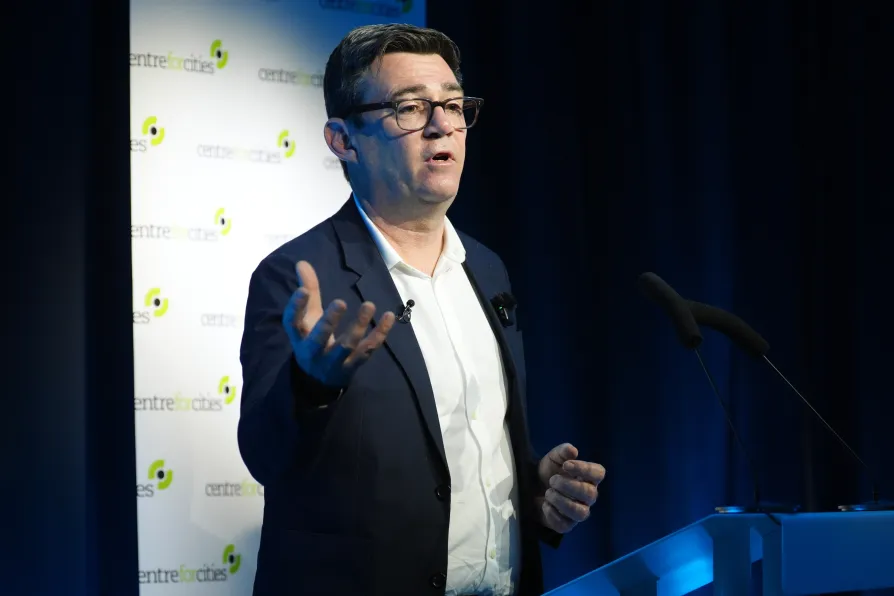 Greater Manchester Mayor Andy Burnham delivers the keynote speech at Centre for Cities event at the British Library in central London, March 4, 2026





LABOUR could see off Reform with a “Burnham bounce” if the Greater Manchester mayor replaced Sir Keir Starmer as Prime Minister, latest polling revealed today.
The findings came as Mr Burnham plunged into the by-election fight in Makerfield, a poll which looks set to define Labour’s future.
The government, however, was struggling to get on top of the cost-of-living crisis as supermarket bosses responded with outrage over a suggestion that they might voluntarily curb price rises on essential items.
The poll by More in Common was bad news for both Reform and the Greens. It showed a Burnham-led Labour Party would pull ahead of the hard-right party mainly by taking votes back from the Greens.
Labour’s share of the vote would jump by around 8 per cent to 30 per cent under Mr Burnham’s leadership. Reform would still secure 27 per cent, with the Tories on 20 per cent, the Liberal Democrats 11 per cent and the Greens falling heavily to 7 per cent.
This would put Labour in sight of re-running the situation that gave them victory in 2024, when the right was deeply divided and the left vote was more consolidated.
More in Common UK director Luke Tryl said: “It looks like Andy Burnham’s appeal extends beyond Greater Manchester.
“In a hypothetical general election, he could give Labour a lead over Reform — winning back progressive voters who have drifted away.”
Mr Burnham will hope that his chances of clearing the first hurdle — victory in Makerfield — will have been helped by announcements today by Sir Keir that the government was extending a freeze on fuel duty until the end of the year, as well as targeting help at hauliers with a 12-month exemption from road tax.
The move is a U-turn by ministers, who had insisted that the fuel duty freeze, first introduced by the Tories, would be phased out from September.
Another plan floated by the government, to persuade supermarkets to consider a price freeze of their own, was rejected by furious fat-cats.
Treasury minister Dan Tomlinson had indicated that ministers were looking for self-restraint by the high-street monopolies, while stressing that there was no question of mandatory price caps.
“The government is going to be having conversations with supermarkets about what more we can do to support households, but no, we are not going to be implementing a mandatory price cap,” he said, adding that the government would be “talking to industry about the steps that they could take to support people with the cost of living.”
The move came after Scottish First Minister John Swinney had pledged action on food prices and Foreign Secretary Yvette Cooper had warned that the world was drifting into a “global food crisis” as a result of the imperial aggression against Iran.
Retail bosses were not in favour. Stuart Rose, former chair of Marks & Spencer and Asda, and now a Tory peer, said: “This smacks of state control, it’s idiotic, it’s dangerous and it’ll never work.”
Soaring supermarket profits, he added, showed that “capitalism does work and customers get great choice.”
M&S boss Stuart Machin, whose company last reported profits of around £4.5 billion, called the plan “completely preposterous” and demanded tax cuts instead.
And Helen Dickinson, chief executive of the British Retail Consortium, blamed ministers for price rises.
“Rather than introduce 1970s-style price controls and trying to force retailers to sell goods at a loss, the government must focus on how it will reduce the public policy costs which are pushing up food prices in the first place,” she said.
Sir Keir, meanwhile, had indicated that he may try to hang on in Downing Street until the end of the year. And he believes that, even if Mr Burnham prevails in Makerfield, a subsequent Labour loss in the resulting by-election for Greater Manchester mayor might undo his hopes.
Mr Burnham’s main rival for the succession, former health secretary Wes Streeting, told MPs that the government risked handing power to Reform leader Nigel Farage.
“I left the government because we are in the fight of our lives against nationalism, and it is a fight that we are currently losing,” he said in his resignation speech.
“Unless we change course, we risk handing the keys of No 10 to Reform. And I do not want that on our consciences.”