All the evidence shows voters want Labour to shift to the left — but initial signs from Andy Burnham are worrying on that front, cautions DIANE ABBOTT


 Latest editorial
Error message
An error occurred while searching, try again later.The case for black self-organisation
The route to liberation does not lie in waiting for allies or chasing representation for its own sake – it requires consistent political strategy and collective struggle, writes ROGER McKENZIE
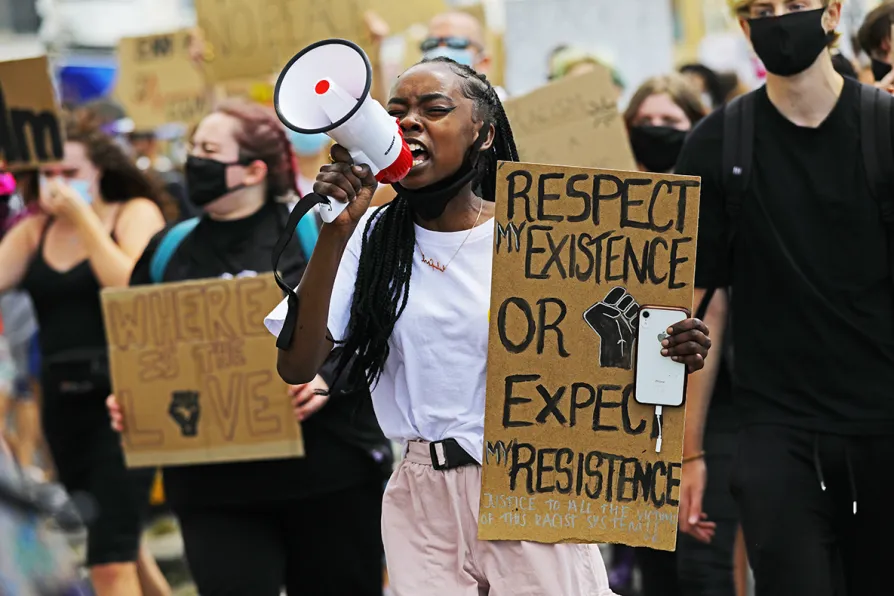 People take part in a Black Lives Matter protest in Brighton, sparked by the death of George Floyd, who was killed on May 25 while in police custody in the US city of Minneapolis, July 2020
ANDY McDONALD MP says Labour must show it is capable of delivering real improvements in people’s lives — bold action is required
ANGUS REID and ANDREW JOHNSTONE report on an initiative that we must take this summer
ALLISON FEWTRELL on what Plaid Cymru's historic election victory means for the communities being failed by Wales’s housing crisis, and four things the new government can do right now
France Insoumise MP JEROME LEGAVRE speaks to Christophe Domec on building the Europe-wide peace movement that came together in the International Conference Against War last weekend
At last weekend’s International Conference Against War, LINDA PENTZ GUNTER talks to the Palestinian physician and politician about the struggles ahead to achieve a truly free Palestine





THE TUC Black Workers Conference took place last weekend. This helped me to reflect on the principle that lays at the heart of the conference: black self-organisation (bso).
I just wanted to break this term down a little.
Firstly, the term “black” which, as you can see, I have not capitalised, in line with the style guide of this paper. But, should you read any of my books, you will see that it is capitalised.
This paper uses the Associated Press as a source for our international news stories but we do not follow its style guide and don’t have to. It’s entirely our decision and I respect that.
The AP took the decision to capitalise black in a “racial, ethnic or cultural sense, conveying an essential and shared sense of history, identity and community among people who identity as black, including those in the African diaspora and within Africa. The lowercase black is a colour, not a person.”
A majority of news outlets are now capitalising black, even the far-right Fox News.
Addressing this issue is far from performative or a distraction from the very real issues facing black workers.
Words and the way that they are used matter greatly.
The use of the term black has been a big issue at the TUC Black Workers Conference for as long as I can remember. Some unions have even attempted to change the name of the conference to various combinations of the multiple acronyms that have emerged and grown.
This year’s conference saw the increased use of the term “black and brown,” which I don’t particularly like.
So far unions have rejected this change in terminology because the issue stretches far beyond grammar or what might look good on a page.
The simple way of handling this is to capitalise the b in black to refer to people of the African and Asian diaspora. Lowercase black can be used to describe a colour.
A Sivanandan, the former leader of the Institute for Race Relations, now enriching the ancestors, once said that “black is not the colour of our skin, it’s the colour of our politics.” Something with which I wholeheartedly agree.
The term black helped to unite people of African and Asian heritage during the racist attacks of the 1970s and ’80s. In forging this unity there was never any question of reducing anyone’s pride in their African or Asian heritages much less anyone’s religious beliefs.
For me the use of the term black in building unity and collective organisation against racism as well as the word’s capitalisation, is important to acknowledge that slavery and colonialism very deliberately stripped away identities of those being exploited.
Let me now turn to the question of self-organisation. This is the principle under which many of the black groups were organised within trade unions and the Labour Party.
For more details about how and why black workers organised together in a number of trade unions and the Labour Party, including the obstacles put in their way by the officialdoms, read my book African Uhuru: The Fight for African Freedom in the Rise of the Global South.
Here I just want to say what bso is not. It is not identity politics as some have falsely attempted to label it in the past. This is in fact highly insulting.
The demand to have our blackness recognised as a central part of who we are does not undermine class solidarity. What has undermined class solidarity is years of being patronised or ignored by people who claim to be our comrades and feel more comfortable fighting racism thousands of miles away rather than that which exists in their own backyard.
Either that or they draw comfort from theorising about the roots of racism rather than actually organising in their communities against it.
That’s part of the reason why black people have been forced to organise ourselves often in the face of hostility from many who claim to be our comrades.
Bso is also not “black — let’s ask everyone else to do this stuff for us.”
I have spent the largest part of my working life being part of union bureaucracies so I get the importance of following the proper procedures.
But bso has never about waiting for a knight in shining armour to come to our rescue or expecting someone else to liberate us.
What liberation we have managed to achieve over centuries of exploitation has been achieved because we have been prepared to stand up and organise ourselves.
We have often been able to carry out the work of liberation with the support of white collaborators — a term I prefer to allies because, at least for me, it implies something more active than someone simply saying they are on my side.
But this liberation must be led by us as black people and not left to the whims of those who have no knowledge of our lived experience.
So, yes, we black workers must ask the TUC and our unions, of which black workers join in proportionately greater numbers than white workers, to do much more, but we must take the lead and organise ourselves within those structures.
I have been on far too many anti-racism demonstrations where black workers are outnumbered by white comrades. This is not a criticism of the black workers. It’s highly likely that they are busy doing one of the two or three jobs they need to do to survive.
The thought that marching down a street on its own will make a difference is clearly nonsense and I’m certain not a view taken by the organisers of these events.
These events are important to rally public support and to build confidence and solidarity. The real difference will come, however, by what we do away from these protests and the often tough conversations that need to take place with those that do not already agree with us.
This tough and unheralded work must be guided by the views and experiences of black workers but white workers are best placed to challenge other white workers.
Bso is often portrayed as being merely about winning more representation at decision-making levels, as if this is a bad thing. But all the evidence shows us that having more black faces in senior spaces on its own will not do it without them having a firm political underpinning.
One look at the current front benches of the main political parties shows that increasing diversity on its own is simply not the answer.
Bso is actually a radical project that has always been about winning revolutionary change in society. That some have clearly used it for their own end, is, frankly, down to a deficiency in black organising rather than anything else. But that’s our problem as black people to solve rather than an excuse not to try to build our power.
Real progress will begin to emerge on race equality when there is strong and effective black self-organisation and white collaborators actually prepared to listen to us and not feel the need to tell us how our liberation should look to them.