All the evidence shows voters want Labour to shift to the left — but initial signs from Andy Burnham are worrying on that front, cautions DIANE ABBOTT


 Latest editorial
Error message
An error occurred while searching, try again later.Rebuilding Solidarity – unions and the fight against the far right
GAWAIN LITTLE looks at the causes of the far-right resurgence and explains how the General Federation of Trade Unions is helping to combat it
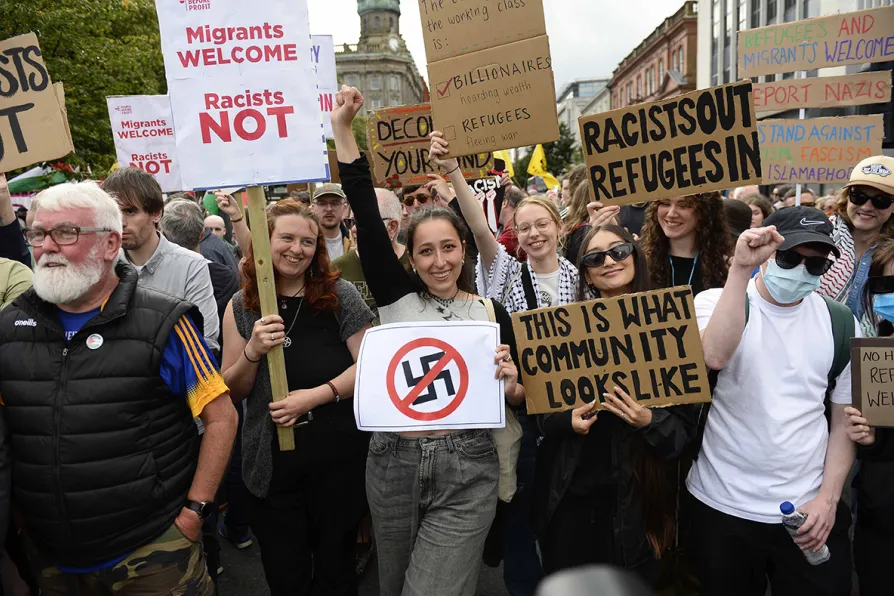 An anti-racism 'Unity Over Division' counter-protest in Belfast city centre, August 9, 2024

ANDY McDONALD MP says Labour must show it is capable of delivering real improvements in people’s lives — bold action is required
ANGUS REID and ANDREW JOHNSTONE report on an initiative that we must take this summer
ALLISON FEWTRELL on what Plaid Cymru's historic election victory means for the communities being failed by Wales’s housing crisis, and four things the new government can do right now
France Insoumise MP JEROME LEGAVRE speaks to Christophe Domec on building the Europe-wide peace movement that came together in the International Conference Against War last weekend
At last weekend’s International Conference Against War, LINDA PENTZ GUNTER talks to the Palestinian physician and politician about the struggles ahead to achieve a truly free Palestine





ON SEPTEMBER 13 last year, over 100,000 people joined a march organised by the far right.
Speakers on that march talked about the “great replacement theory,” called for the banning of mosques, temples and shrines, referred to migrants as “invaders” and Islam as “the enemy.”
A Palestinian flag was torn up live on stage and Elon Musk dropped in by videolink to call for the dissolution of Parliament and tell the crowd “Whether you choose violence or not, violence is coming to you. You either fight back or you die.”
It would be impossible to describe these views, promoted by the organisers and guest speakers of the demonstration, as anything but far right.
However, it is a leap to conclude that everyone who attended that demonstration is far right, effectively that there are over 100,000 fascists organised in Britain today.
Just like it would be a leap to conclude that Reform’s current popularity in the polls means that 30 per cent of the British population is now racist.
The far right put forward racist policy and rhetoric, which seeks to blame migrants for the economic, social and political crisis this country is in, but the reality is that many people are drawn towards support for Reform, or for far-right street movements, because of the failure by mainstream politicians to address this crisis.
In the words of one Reform voter, reported at a recent training event we ran, “I don’t trust Nigel Farage and I know Reform don’t have the answers I am looking for, but we have to do something so I will be voting for them.”
This is not just anecdotal. At the end of last year, GFTU worked with AI poll modelling and data company Bombe to conduct some detailed poll modelling of support for far right views. The model looked at those who attended the September 13 demonstration and what key issues affected their views.
While it confirmed a lot of what we already knew, for example that those expressing support for far-right views get most of their news from sites like Twitter, TikTok and GB News as opposed to traditional media, it also provided new insights.
Crucially, it showed that, alongside concerns about immigration and fear of crime, fears about the impact of AI, job insecurity and housing insecurity were the most significant drivers of support for far-right views.
Responding to those who feel left behind — economically and socially — who have seen their standard of living decline dramatically over the past 15 years, and who are now worried about whether they will have a job or somewhere to live in a year’s time, is essential to dismantling support for the far right. We need to rebuild solidarity in our workplaces and our communities.
That is the reason that GFTU has been developing training for union reps, activists and members, with the support of the Scottish TUC, and a range of partners including Stand Up to Racism, Black Lives Matter UK, Bombe, SOAS Economics, Acorn and Living Rent, on how to tackle divisive and far-right views in the workplace.
The training is called Rebuilding Solidarity because that is what we need to do — right across our communities.
Clearly, a huge part of what we have to do to challenge the far right is unite and mobilise those who agree with us, through unity events like the Together mobilisation in London next weekend. But if that is all we do, it will be insufficient to push back the rise of the far right.
We need to be putting forward solutions to the crisis we face and winning back our people from anti-migrant, Islamophobic rhetoric which lets the super-rich off the hook for the crisis they created by pitting working-class people against each other, based on race or religion.
That is why the organising strategy unveiled by the Together Alliance yesterday is crucial. It is why the TUC’s new Unity Works campaign is crucial. And it is why events like today’s rally for a second employment rights Bill are essential.
If we want to win working people back away from the hatred and division sown by the far right, we will not do it by telling them they are wrong to be angry, or that things are getting better.
We have to acknowledge and accept that anger, but direct it into campaigns to change our economic circumstances for the better — translate it into putting money back in people’s pockets, to creating job security and ending housing insecurity.
To do that, we need stronger unions and stronger collective rights. Sectoral collective bargaining and returning the right to strike would give working people the levers to drive up wages, to end the casualisation of labour and to take on the profiteers. They would support us to collectivise against our real enemy — those who profit from the exploitation of our labour.
That is why today’s ERB2 campaign rally, jointly organised by Strike Map and the Campaign for Trade Union Freedom, is so important. It is also why we must take this campaign forward on every front.
Gawain Little is general secretary of the General Federation of Trade Unions.
The GFTU Rebuilding Solidarity training will next run on May 5-6 at the GFTU training centre in Quorn, Loughborough. To book your place, visit gftuet.org.uk/courses/rebuilding-solidarity.