All the evidence shows voters want Labour to shift to the left — but initial signs from Andy Burnham are worrying on that front, cautions DIANE ABBOTT


 Latest editorial
The Employment Rights Act: the gaps that still need to be plugged
The unions are unhappy with the Employment Rights Act 2025 and with good reason. KEITH EWING and Lord JOHN HENDY KC take a close look at why the Bill promised more than it delivered
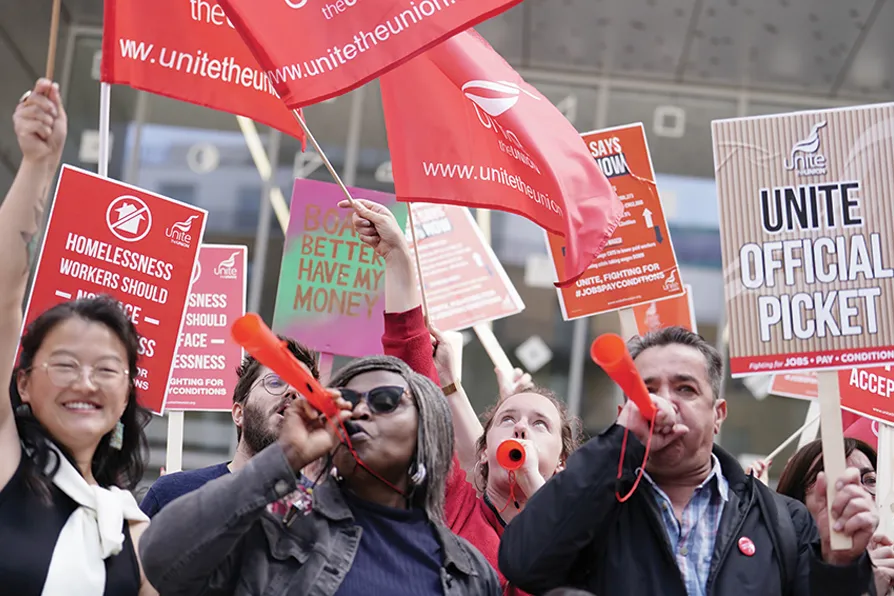 UNION RIGHTS ARE HUMAN RIGHTS: St Mungo's workers outside the homeless charity's head quarters in Tower Hill, London, as they start a month long strike over pay, May 2023

ANDY McDONALD MP says Labour must show it is capable of delivering real improvements in people’s lives — bold action is required
ANGUS REID and ANDREW JOHNSTONE report on an initiative that we must take this summer
ALLISON FEWTRELL on what Plaid Cymru's historic election victory means for the communities being failed by Wales’s housing crisis, and four things the new government can do right now
France Insoumise MP JEROME LEGAVRE speaks to Christophe Domec on building the Europe-wide peace movement that came together in the International Conference Against War last weekend
At last weekend’s International Conference Against War, LINDA PENTZ GUNTER talks to the Palestinian physician and politician about the struggles ahead to achieve a truly free Palestine





I
THERE is a growing demand from the trade union movement for a second Employment Rights Bill. The Campaign for Trade Union Freedom has called a rally for today at the NEU head office to articulate the demand and is likely to be sold out.
The Employment Rights Act 2025, passed on December 18 last year, is hailed as the biggest upgrade of workers’ rights for a generation — so why is a second Bill necessary? The reason is that the Act has left out a lot that should have been included in it.
Readers will remember that it was preceded by an outline of what the legislation would incorporate in a green paper in 2021 called a New Deal for Working People.
It was launched at and endorsed by Labour Party Conference that year and widely proclaimed over the next two and a half years by Sir Keir Starmer, Angela Rayner and shadow cabinet members as the blueprint for the legislation which would be introduced if Labour won the next election.
Just before the election, Labour’s Plan to Make Work Pay: Delivering A New Deal for Working People was published. It stated: “Labour’s New Deal for Working People is our plan to make work pay.”
At the election on July 4 2024 Labour won with a majority of 174 over all other parties combined. This should have ensured that every commitment in the New Deal would be translated into legislation. But at some point the promises got watered down.
We may never know whether that was to do with the “Labour Together” scandal by which business donors funded a party (comprising many cabinet members) within a party to advance its own agenda. Whatever the reasons, we now need to put back what was taken out.
II
So what needs further legislation? Four things stand out.
First of all, the Act does not, as the New Deal promised, create a single legal status of workers (ie everyone who works for someone else and is not genuinely in business on their own account).
The government said there would be consultations over this between late 2025 and early 2026 but that did not happen. It still promises to consult but no alternative dates have yet emerged.
Having missed the 2025 Act, single status will require further primary legislation — indeed, a second employment rights Act.
The need is urgent because the absence of single status in the 2025 Act means that many of the rights introduced by the Act can be sidestepped if the employer successfully changes the legal status of the people it hires.
So, for example, a person whose status is changed from being an “employee” to being “self-employed” will lose the right not to be unfairly dismissed. Other rights go to employees and what the lawyers call “limb (b) workers” but not to those who are neither (eg Deliveroo riders).
Second, the Act does not, as the New Deal promised, include a means of reintroducing multiemployer collective bargaining laying down negotiated minimum terms and conditions across an entire sector of the economy or a particular trade.
Indeed, the government rejected an amendment which would have given the government a mechanism to introduce sectoral collective bargaining in any sector where and when they felt it appropriate.
It’s true that the Act does provide for Negotiating Bodies for Adult Social Care and School Support Staff, but the Act says that these do not constitute collective bargaining. And indeed, they do not comply with the requirements of international law because of the government’s power to dictate what they discuss, who sits on them, and, ultimately to overrule them.
Third, the Act makes some useful changes to industrial action law. The Strikes (Minimum Service Levels) Act 2023 and much of the Trade Union Act 2016 have been repealed.
Strike notice has been shortened (from 14 to 10 days), ballot and strike notices have been slightly simplified, the ballot participation threshold of 50 per cent has gone, while protection against dismissal and detriment for striking officially has been strengthened.
Moreover, electronic balloting may be introduced (subject to consultation) and, if so, the 40 per cent voting threshold will be removed in the six sectors where it is currently required.
But all this goes nowhere near reversing the restrictions on industrial action piled on by the Thatcher/Major legislation between 1980 and 1993.
The New Deal insisted that “the laws regulating industrial action should ensure that UK law complies in every respect with the international obligations ratified by the UK, including those of the International Labour Organisation and the European Social Charter.”
For over 35 years those bodies have pointed out that our industrial action law is in breach of those obligations in a multitude of ways. Some have been addressed by the 2025 Act. But many others have not.
For example, the complete bar on all forms of solidarity action and the requirement that unions notify employers, in detail, that they intend to hold a ballot for industrial action have been repeatedly condemned as incompatible with the UK’s international obligations.
Finally, the Act builds on a peculiarity of UK labour law, that of substituting collective negotiation by individual litigation.
The Act depends on individual workers taking their complaints to employment tribunals. These are places where the worker (unless represented by a trade union — and unions have very limited resources) will not feel at home and will probably be outgunned, if not by employer’s lawyers, then by professional human resource managers or consultants.
Tribunals currently have 52,000 open cases with waiting times for hearing ranging from one to two years. Statistically more claims are lost by applicants than are won, and research shows that, for those who do win, one-third of compensation awards are never paid.
True, the Act will establish a Fair Work Agency which can take a case if a worker does not. But there are questions already about whether the Agency will have sufficient resources, adequate powers, the motivation to make a real difference by active intervention.
III
There are many other aspects of the Act which need tightening but the above shows the crying need for a second Bill. But the priority now is:
• a single status for all workers so that all those who work for a living are fully protected by labour law unless they are genuinely running their own business as entrepreneurs. There should be no fudges or compromises: labour rights’ protection should be universal.
• the extension of sector-wide collective bargaining to reverse the decline in collective bargaining coverage, in order to enhance worker voice, improve pay and working conditions, and ensure the speedy resolution of worker grievances without the need to take cases to employment tribunals.
• the removal of restraints on trade union freedom to comply with international labour standards, breach of which has been drawn to the attention of successive British governments for over 35 years. The rule of law requires nothing less.
It is completely unacceptable that trade union leaders risk imprisonment for breaking domestic laws which are themselves a violation of the government’s obligations under international law.
Just over 18 months ago Lord Hermer, the Attorney General, expressed concern that “faith in international law, and the international rule of law, is being chiselled away in communities who are told, time and again, that the system is failing to deliver for them.”
This was the time “to reaffirm that the rule of law both domestically and internationally” as “the necessary precursor” to “democratic values,” Lord Hermer said, adding that “international law is not simply some kind of optional add-on, with which states can pick or choose whether to comply.”
We agree.
But until the government addresses the rule of law deficit affecting trade unions these sentiments are hollow, as is the Attorney General’s commitment to rebuild the “UK’s international rule of law leadership.”
There can be no celebration of international law by a British government while it routinely ignores the judgement of the international community about the continuing legacy of Thatcher’s repressive labour law.
Apart from anything else, it is extraordinary that a Labour government continues to tolerate and even embrace the restrictions under which trade unions now operate, and even more extraordinary that some trade union leaders now appear to accept them as permanent features of their members’ disempowerment.

Similar stories

The new Employment Rights Act is a step forward, but restoring collective bargaining and union power remains essential to tackling insecurity, outsourcing and low pay, says PAUL WHITEHOUSE

Labour must not allow unelected members of the upper house to erode a single provision of the Employment Rights Bill, argues ANDY MCDONALD MP

The Bill addresses some exploitation but leaves trade unions heavily regulated, most workers without collective bargaining coverage, and fails to tackle the balance of power that enables constant mutation of bad practice, write KEITH EWING and LORD JOHN HENDY KC

It is only trade union power at work that will materially improve the lot of working people as a class but without sector-wide collective bargaining and a right to take sympathetic strike action, we are hamstrung in the fight to tilt back the balance of power, argues ADRIAN WEIR