JAMES NALTON celebrates Ruben Blades’s song Patria – played before Panama’s game against Ghana — a song inspiring hope instead of hate


 Latest editorial
Error message
An error occurred while searching, try again later.The rise and fall of Prince Naseem
JOHN WIGHT explores the Greek tragedy beneath British boxing’s most dazzling ascent — Prince Naseem Hamed and the mentor who shaped him
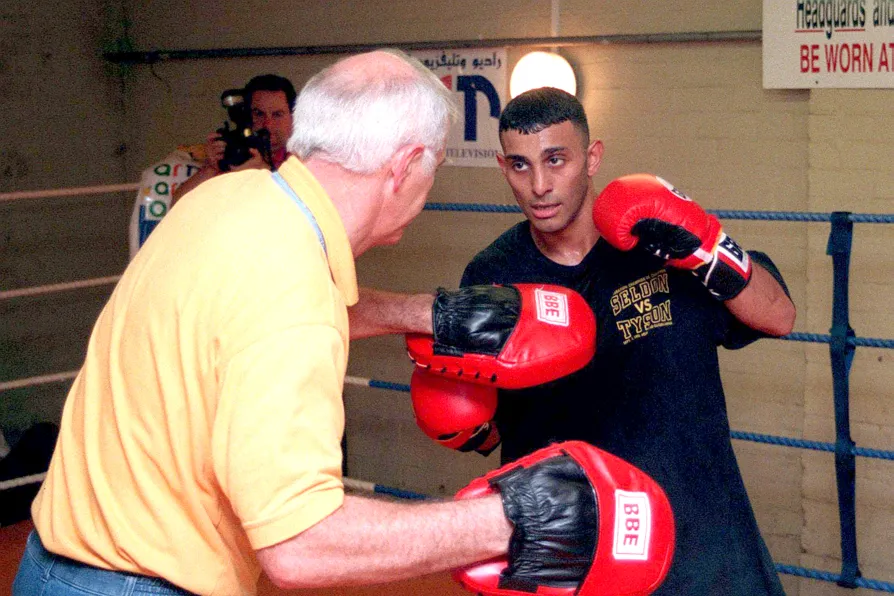 Prince Naseem Hamed with his trainer Brendan Ingle in Sheffield preparing for his WBO featherweight title defense against Jose Badillo, October 8,1997
Fifty years ago this month, Britain faced its hottest summer on record, as welterweight champion Stracey met his match in Mexico’s Palomino, writes JOHN WIGHT.
Including races at Newcastle, York and Chester





WHEN in April 1992 an 18-year-old flyweight entered a professional boxing ring for the first time at Mansfield Leisure Centre, no-one in attendance could possibly have predicted what he would become?
The young fighter’s name was Naseem Hamed, he would come to be known as Prince Naseem Hamed or Naz, and he would go on to generate more excitement and column inches than probably any British fighter ever has before or since. The fact that he was Arab, Yemeni, and proud at a period in British society in which Arabs and all people with brown skin were routinely dehumanised as “Pakis” — this added an extra dimension of wonder at the unalterable confidence which this precocious young fighter from Sheffield radiated.
It is why the movie of his incredible journey in the sport, Giant, has created such interest, despite the passage of time that has elapsed since he retired from the ring in 2002 and the movie’s release on January 9 this year. Let there be no doubt, however, that Naseem Hamad’s “incredible journey” is indistinguishable from the role of his longtime coach and mentor, Brendan Ingle, throughout. It is a relationship which informs the movie’s dramatic core, and rightly so.
The relationship between Hamad and Ingle was of such intensity that it traced the contours of a Greek tragedy — first wonderfully close, pure, and mutually beneficial, then increasingly fractious as fame and money stepped in the picture, before ultimately ending in acrimony and a bitter parting of the ways.
At his Wincobank in Sheffield, Brendan Ingle — an Irish migrant to British shores — did not so much train kids as rear them in this post-industrial steel town. Determined to make his gym a safe space for all — regardless of race, religion, or creed — the result was a kind of multicultural magic that produced a slew of British, European and/or world champions.
And if not turning them into champions and top contenders, Ingle at least helped mould them into responsible adults, instilling along the way old school values of honesty, persistence, dedication and integrity as the foundations of success in life.
Hamed was seven when he first came into Ingle’s life. His father, a local shopkeeper, had brought him to the gym, deciding that because he was so small he should learn how to look after himself. Call it fate, destiny, kismet — call it whatever you want — it was a meeting that would provide boxing fans with more drama than a Rocky movie as Ingle’s unorthodox methods and approach to the sport found expression in the perfect student.
Who following his career could ever forget Naz preening and dancing in front of his opponents, hands by his waist inviting them to hit him, before unleashing an uppercut from the floor at such ferocious speed you had to rub your eyes, unwilling to believe what they had just registered?
His balance was extraordinary and at times it was as if he was made of rubber, the way he leaned back so far to avoid punches that he appeared to defy gravity. Rather than try to train such unorthodox traits out of his young fighter, Ingle instead encouraged and worked on enhancing them. Here, perhaps, lay his singular genius as not only a boxing coach but as a bona fide boxing guru and visionary.
Hamad carried power in both hands, could throw punches from any angle and was able to switch from southpaw to orthodox at will. He could also take a shot, evidenced in his epic fight against Kevin Kelley at Madison Square Garden in 1997 — his stateside debut — in which he suffered three knock-downs before coming back to win by TKO in the fourth round.
Then there were his ring entrances, legendary in themselves, which had the crowd everywhere he fought raising the roof at the sheer spectacle. In his time Naz made his way to the ring on motorcycles, flying carpets, on a trapeze, while dancing and miming with so much energy that you were left wondering if he’d forgotten that he was actually there to fight.
His journey through the ranks from that 1992 debut in Mansfield was astonishing. He took the European bantamweight title in only his 12th fight before going on to claim the WBO featherweight title, followed by the IBF and WBC featherweight titles soon thereafter.
His career finally came crashing down in 2001, when he suffered a heavy points defeat to Mexican legend Marco Antonio Barrera at the MGM Grand in Las Vegas. But by then, like Icarus of Greek mythology lore, Naz had flown too close to the sun. Money and fame had corrupted him to the point where he was spending more time in nightclubs than in the gym, and giving more attention to his luxury car collection than his roadwork. His relationship with Ingle was cast aside in the process, public insults were exchanged, and never were they to be reconciled afterwards.
In the movie, all of these high and low points are covered with due skill. Playing Hamad is Amir El-Masry, while in the role of Ingle is Pierce Brosnan, who brings surprising pathos to a role you would automatically never associate with a former James Bond. Written and directed by Rowan Athale, the movie’s premiere and release benefited from the appearance and endorsement of the now ballooned-up Naseem Hamad himself.
Naz, now 51, said in one of his many interviews to promote the project: “I wanted to see Brendan and say sorry for the nasty things I said about him, because I am so grateful for the things he did for me. The time I had with Brendan was an amazing time. It was priceless.”
A scrawny young Yemeni kid and an Irish boxing guru, as unlikely a combination as you could imagine, yet one that achieved nights of excitement and drama in a boxing ring that have never been bettered. It really and truly is the stuff of movies.
Giant is currently on general release in cinemas across Britain.