Latest editorial
Error message
An error occurred while searching, try again later.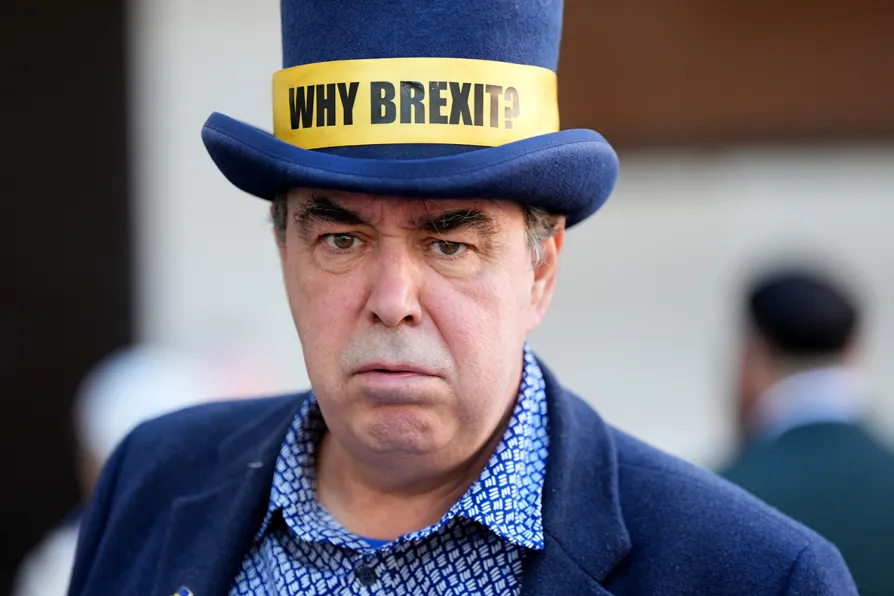 Anti-Brexit protester Steve Bray arrives at Westminster Magistrates' Court, after he pleaded not guilty to failing without reasonable excuse to comply with a direction given under the Police Reform and Social Responsibility Act 2011, April 14, 2025





A DANGEROUS tendency is emerging in the labour movement to reopen the Brexit question. Several government figures have started to criticise the impact on the economy of Britain leaving the European Union.
Health Secretary Wes Streeting, the government’s leading Blairite, has raised the possibility of Britain re-entering the EU’s customs union, a move which would subordinate trade policy to Brussels and subject much economic activity to EU regulations.
TUC general secretary Paul Nowak spoke in similar terms shortly before Christmas. So far, Keir Starmer has not embraced the customs union proposal.
However, the arguments he advances are purely pragmatic – that rejoining would mean Britain having to renounce the trade deals signed in its own right, most notably with the USA.
However, that is a thin argument since the Trump administration has either not ratified, not implemented or not even really agreed the much-trumpeted headline deals.
Ministers appear to be hoping that better trading arrangements with the European Union would stimulate the economic growth still lamentably absent in Britain.
These arguments are false and risk sending the movement up a blind alley. The vote to leave the European Union was one of the largest democratic mandates in Britain’s history.
Support for leaving was particularly, and unsurprisingly, strong among the working class. While reasons for voting for Brexit were many and varied, and some had a reactionary colouring, it was in essence a vote against a status quo upheld during the referendum campaign by all major political parties, the CBI and the TUC.
At least one of the reasons for working-class support for Brexit was creating the space for state-led economic intervention to bring jobs, in manufacturing above all, back to former industrial districts. People well understood that the EU’s neoliberal rules rendered such a return to social democracy impossible.
The radical changes sought have not been delivered. While Britain remained under Tory rule they were never going to be. Austerity and the interests of the City of London were always going to be Conservative priorities, and this Labour government has shown no inclination to break with them.
Thus frustration has only grown, and is increasingly being directed against new targets, migrants first of all, by the populist right.
Yet the potential remains. The labour movement needs to be pushing the government to adopt those policies of economic intervention which are the only solution for the economic misery which has seen living standards stagnate for a generation.
Snuggling up to the EU – and it would likely prove that rejoining the customs union would only be a first step, to be followed by reintegration into the single market with its binding commitments to the free movement of capital, and then by reversing into the EU completely – forecloses far more opportunities than it opens up.
And Britain in the European Union 2.0 would be worse than first time around, since it would likely be obliged to join the single currency, opening the way to the sort of bankers’ dictatorship imposed through the euro on Greece and elsewhere in recent years.
It would prohibit such measures as domestic preference in public procurement, state subsidy for decisive industries and even, in some cases, public ownership. In short, it would render impossible the very programme that Britain needs.
And it would surely divide the political coalition progressive politics requires, further alienating many working-class voters in the so-called “red wall” areas. The lessons of the defeat of Corbynism in 2019 must not be forgotten – parties will pay a price for ignoring democracy.
So let the movement focus on demanding the economic programme Britain needs, not restarting the debilitating Brexit debate.