All the evidence shows voters want Labour to shift to the left — but initial signs from Andy Burnham are worrying on that front, cautions DIANE ABBOTT


 Latest editorial
Error message
An error occurred while searching, try again later.TUC Young Workers: why class politics matters in trade unions
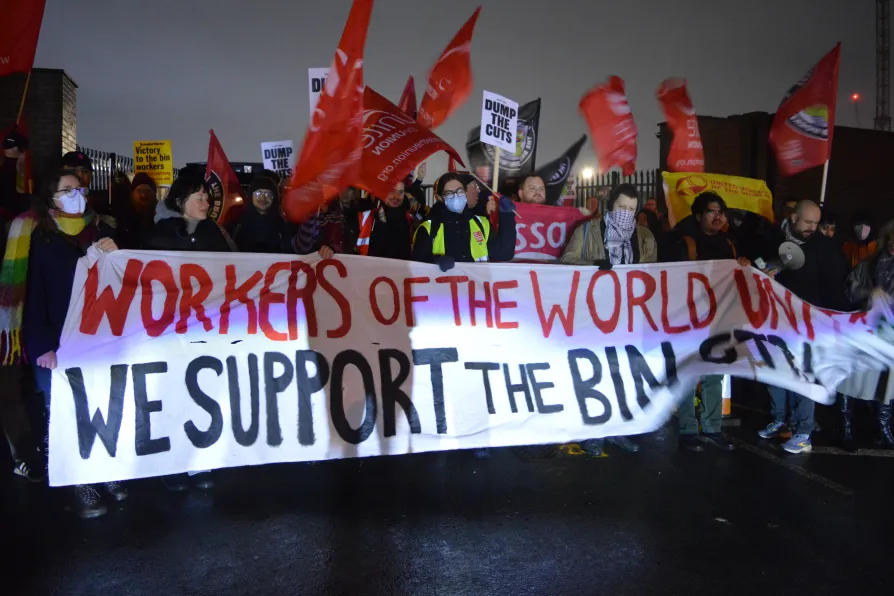 [Pic: Henry Fowler, Strike Map]
ANDY McDONALD MP says Labour must show it is capable of delivering real improvements in people’s lives — bold action is required
ANGUS REID and ANDREW JOHNSTONE report on an initiative that we must take this summer
ALLISON FEWTRELL on what Plaid Cymru's historic election victory means for the communities being failed by Wales’s housing crisis, and four things the new government can do right now
France Insoumise MP JEROME LEGAVRE speaks to Christophe Domec on building the Europe-wide peace movement that came together in the International Conference Against War last weekend
At last weekend’s International Conference Against War, LINDA PENTZ GUNTER talks to the Palestinian physician and politician about the struggles ahead to achieve a truly free Palestine




THIS weekend is TUC Young Workers’ conference, and it is occurring with the shadow of our country’s economic and international situation looming over us.
It is increasingly likely that the Labour government will do nothing to change our set of circumstances, with their lack of imagination for a future or political project being framed as “hard choices.”
Everything that was stable or rising on a graph in 2010 has gone down; test scores, health, mental health, home ownership.
The past four decades of neoliberalisation has atrophied the muscles of a class movement. Labour clubs have closed down or are plastered with Reform and Ukip posters. Union halls are relics to be visited.
There’s a unique perspective to be had as a public-sector worker in their 20s, as not only is the future of our jobs looking worse, but our trade union movement is as well.
Trade union membership density has fallen dramatically or stagnated in most unions. Our education unions are splintered into multiple bickering entities — with professional unity being akin to pulling teeth, instead of one major union representing education.
Youth networks in unions are small. Healthcare workers must navigate the workplace organising politics of multiple unions as well.
So, the four-decade assault on Britain’s industries and their workers as well as the hangover from austerity has weakened public services and our unions are not prepared as they should be to fight them.
A young teacher sees that austerity has starved the children they teach, a young nurse or ambulance driver sees that the hospital they work at is at its breaking point with wait lists and emergencies.
A civil servant sees that their local government is not adequately funded to provide the basic services they need. We are a generation where things have only declined.
Unions have the potential to be a bulwark against the assault our generation has faced, major battles have been fought and won by the members and leadership of the RMT and NEU in recent years, to name a few.
The common denominator between both unions is that they are not affiliated with the Labour Party. The Labour-affiliated unions are engaged in what can only be dubbed an abusive relationship with the Labour Party, showering them with money despite being slapped in the face time and time again.
As a result, it is no surprise that our unions are engaging less with educating their members on vital subjects that shape the material, concrete conditions of our workplaces such as political economy and understanding the legislation and history of the ruling class that has tried to crush the trade unions time and time again.
Instead, the focus of some TUC affiliated union educational offerings to its young members are topics that have nothing to do with how we got here, or how to build strong, class-based movement.
The topics of personal identity, individualised experiences and categories have subsumed practical topics of workplace organising and an awareness of the ideological and economic forces that have moulded our society.
Some of the former topics have their time and place, especially the endemic violence against women and girls and rise of misogyny, which I see on a weekly basis as a secondary school teacher.
But if we want to unions to be a vehicle to get young working people out of bed and engage with workplace democracy, we have to speak the plain, universal language of class.
Moreover, class politics is related to the situation we found ourselves in today — an economic assault on the working class and trade union members. When we investigate the political forces behind the deteriorating conditions in our workplaces, then we make it real to our members.
For example, as a member of the NASUWT , I would find it important to education my branch and workplace members about where our money is going with the simple example of comparing the apparently unlimited funds for funding proxy wars and promoting foreign direct investment, all the while we are being offered a below-inflation, unfunded pay rise spread over two years.
The young worker who injects politics into their workplace bridges the gap between trade union consciousness, which builds a workplace, to class consciousness, which changes the world.
Do I think that the colleague that I tell this to will become Scargill overnight?
No, a trade union cadre knows that building a militant workplace takes persistent, patient work. But trade union membership does not exist to give you a discount on a holiday, trade unions do not exist to teach about diversity or the politics of identity, they are part of a movement that has the potential to train us in the organising skills required emancipate us from the situation we find ourselves in today.
Matt Flamenco is a member of the NASUWT Young Members Advisory Committee and YCL industrial officer.