Latest editorial
Error message
An error occurred while searching, try again later.
BRANDON WILLIAMS explains why perfection and structure may be holding Arteta’s side back
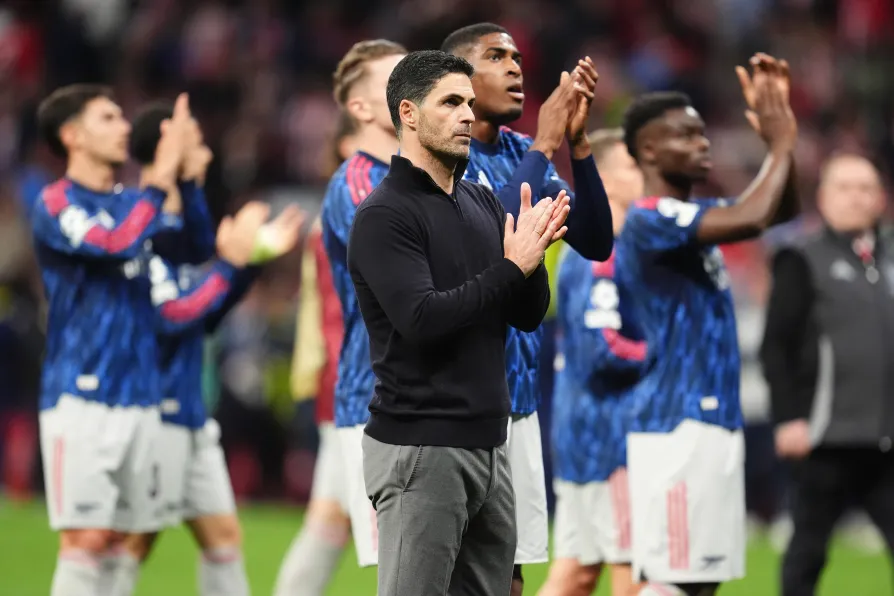 Arsenal manager Mikel Arteta applauds the fans after the UEFA Champions League semi-final first leg match at the Riyadh Air Metropolitano, Madrid, April 29, 2026
All to play for at Ashburton Grove next week as Arteta’s Arsenal draw with Atletico





MARTY SUPREME is not a film about football. In fact, it is hardly a film about table tennis. Despite that, it does offer some insight into the current Premier League title race.
Firstly, this should never have really been a title race. Upon beating Everton 2-0 in March, Arsenal were 10 points clear of Manchester City and have been largely comfortable leaders all season.
After a 2-1 defeat to Pep Guardiola’s men a month later, and the Cityzens’ subsequent victory over Burnley days afterwards, they were bumped down to second after a sequence of confidence-knocking performances and damaging results.
A victory against Newcastle has reinstated them atop the table at the time of writing, though it has appeared that a season of consolidating, risk-averse football has ultimately caught up with the red half of north London.
While most of the league have embraced direct, frenzied styles of play, Arsenal moved even further into their high possession, dictatorial methods that have seen them rely on repeatable scenarios and organised fluidity.
Their recruitment and desire to break down matches into predictable situations means they have tamed what has been a chaotic time tactically in English football.
Guardiola, whom Arteta learnt under as a coach in Manchester, has often been held up as the manager who has wanted to exact the most control possible over games. However, Guardiola’s ability to take risks is a largely underplayed part of his coaching.
Namely that in an intensely physical Premier League, where almost any team can beat another, the Catalan has largely maintained his pass-happy, pinning back the opponent’s game plans, despite counter-attacks continuously causing problems, man marking constricting space and set-pieces becoming all the rage. In terms of the latter, Guardiola has even stated: “there are other things I prefer to work with.”
There have been some tweaks — a risk in itself. See his wingers as one example. When City beat Arsenal 4-1 in 2023, it was the technical Jack Grealish and Bernardo Silva starting out wide. In April 2026, it was the blistering dribblers Jeremy Doku and Antoine Semenyo.
City’s assistant coach Pep Lijnders — formerly of Jurgen Klopp’s Liverpool — acknowledged: “where [teams] play man to man, there are no lines, there are no pockets, there are no free spaces. It’s all about how to play [through] that movement of high pressure.”
Even so, the goal is still to find possession-based principles against tightly guarded defences, who are more often utilising harrying markers and require the Semenyos and Dokus of the world to find those solutions.
Importantly, there is an acceptance that things won’t always be perfect. Guardiola attested to this when discussing why he prefers passing in the centre of the pitch than out wide.
“Of course, if you lose the ball in the middle, it’s a risk and you screwed up. But it’s a decision. The coach has to make a decision. Because it’s going to happen to you. You’ll lose balls in the middle and the rival will score on the counter-attack.
“You will come home and question your idea. But in front of your players, you will ask yourself two questions: change the style or insist on my idea?
“If you insist you’ll be fine. If you change, you’ll be finished.”
Or as the silverware laden fox put it in 2021, “Winning depends on so many things that you cannot control.”
Contrast this with Arsenal, who not only want to have the ball as much as City but they conceded minimal counter-attacks and lead the way in set-piece goals.
They brought in a specific kind of profile, seemingly built by masons of modern football. Physically imposing players that also have excellent technical quality, such as Declan Rice, Riccardo Calafiori and Martin Zubimendi.
Arsenal are built to subjugate opponents. The Gunners try to make every battle a duel, where one bullet is more decisive than rounds of relentless ammunition.
“Control is not really a word that I like,” Arteta admitted. “I like dominance and don’t allow teams to breathe instead of control.”
That has worked for large parts of recent seasons. Yet, again at the business end, they still look vulnerable.
Enter Timothee Chalamet.
The protagonist of Marty Supreme, Marty Mauser, is a world-beating table tennis player and skint. The film suggests that Marty’s self-belief and arrogance propels him to becoming the elite player he is.
By that same token, that attitude also causes his own self destruction. It means he flies by the seat of his pants and has precious little structure — financial and emotional — around him besides the goal of winning the World Championship, which makes achieving that aim nigh on impossible.
The core question being: if Marty was less bullish, he would likely be able to create that structure, but would that make him a weaker table tennis player, thus less likely to be in contention for winning?
Taking this back to Arsenal, they have become the strongest team in the Premier League by continuously honing in on Arteta’s search for dominance in every aspect of the game. However, they have yet to win any silverware through this and still wobble when the pressure ramps up.
The core question then becomes: if Arsenal played in a less dominating way, they would likely be more comfortable in freer-flowing, open game states, going punch-for-punch, but would that make them a weaker team overall, and thus less likely to be in contention for the league come April?
Essentially, have Arsenal got as far as they can playing this way?
Lifting a Premier League or Champions League is not to be sniffed at, but, even if they do so, the nervy end to things has proved that trying to dominate football matches in this fashion is ultimately unsustainable when the league has become ever more competitive, and so many teams play transitionally.
Additionally, key players have missed large chunks of the run-in. Whether that is directly down to the physical or mental toll of playing such a demanding way is arguable. However, the pressure to get over the line has been wearing on Arsenal season-upon-season. Perhaps, ironically, being more unshackled at their most insecure period of the year may aid that.
But taking into account Guardiola’s thoughts on insistence and Arsene Wenger’s previous advice to Arteta “to continue to have a grip on the team … and to go to the end of his beliefs,” it would appear the solution is the opposite.
To go even more extreme in the pursuit of ultimate dominance.
Arteta himself alluded to this last month. “I would like to play with three extra players in my half to get some beautiful football and always play against a free man. You want to watch that football [then] you have to go to a different country because in the Premier League, for the last two or three seasons, this is not the case.
“It’s going to be a different game unless we change the rules because the evolution of the game is that. Four years ago it was a completely different game.”
It is akin to Marty Mauser’s assertion. “I have an obligation to see a very specific thing through. And with obligation comes sacrifice.”
May will be yet another testing time at Ashburton Grove. While it is impressive how much dominance they have been able to assert for the majority of the campaign, it feels as though a trophy (or two) now would be deserved rewards for the past four years work, rather than a platform for a dynasty.
Though claiming one title would finally give them the psychological assurance that City have, for example, football’s fluctuation in the 2020s means winning is arguably less guaranteed than ever before and that a continued pursuit of dominance may see their hopes of silverware hinge on eliminating errors and freak occurrences that will just simply happen sometimes.
It is a battle against the footballing deities.
“If God exists and one day I go up there and he will ask: ‘Do you want to come in? What have you done in your life?’” Wenger once said in his final few years in north London.
“And the only answer I will have is: ‘I tried to win football games.’ He will say: ‘Is that all you have done?’ And the only answer I will have is: ‘It’s not as easy as it looks.’”