The new Employment Rights Act is a step forward, but restoring collective bargaining and union power remains essential to tackling insecurity, outsourcing and low pay, says PAUL WHITEHOUSE


 Latest editorial
Error message
An error occurred while searching, try again later.Fear, US power and a fractured left: How Milei tightened his grip on Argentina
Marxist economist JULIO GAMBINA tells Bert Schouwenburg why voters backed Javier Milei despite soaring poverty, how Washington is shaping Argentina’s future, and why the unions and wider left have yet to form a force capable of halting the far-right project
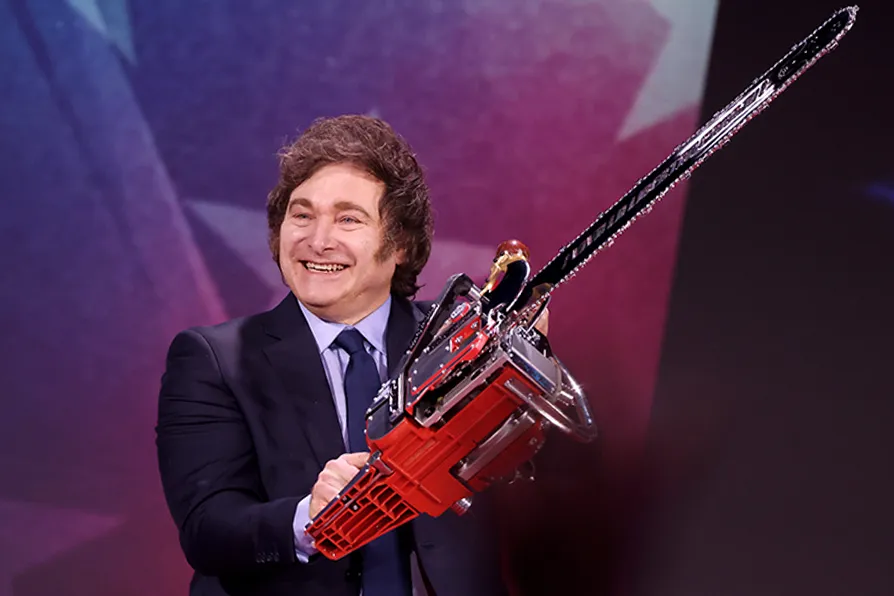 ONE-TRICK-PONY: President of Argentina Javier Milei speaking at the 2025 Conservative Political Action Conference (CPAC) at the Gaylord National Resort & Convention Center in National Harbor, Maryland, US / Pic: Gage Skidmore/flickr/CC

Trade unionists are mobilising to support Cuban workers and public services, amid escalating US pressure on the socialist island. RONAN OGILVY explains
The defence secretary’s resignation reveals not a split over principle but a dispute over pace of military spending, as Britain’s political Establishment unites behind deeper Nato commitments, argues NICK WRIGHT
The ceasefire may have halted the fighting for now, but years of economic warfare and recent military attacks have left millions of Iranians facing hardship and uncertainty, says Codir’s RUBEN BRETT
The struggle for Palestinian freedom has become a defining issue for everyone committed to justice, democracy and peace, says PETER LEARY ahead of the Stop the War International Conference on Saturday
Unison director of organising KEVIN LUCAS explains the Organising to Win strategy, its successes to date and key tests on the union’s horizon




JULIO GAMBINA is a prominent Argentinian Marxist economist and university professor specialising in political economy, external debt and the global crisis of capitalism.
He has published numerous books and articles and appears regularly on the independent Barricada TV channel. I recently caught up with him at his offices near the national parliament in Buenos Aires to ask him some questions on behalf of the Morning Star.
Bert Schouwenburg: Following the Peronist victory in the Buenos Aires provincial elections, the opinion polls predicted another defeat for President Javier Milei’s Liberty Advances (LLA) party in the October midterm parliamentary elections. However, despite rising unemployment, unprecedented poverty levels, and a cost-of-living crisis, LLA emerged victorious across the country, including in Buenos Aires. Were you surprised by this result and how do you explain it?
Julio Gambina: The result surprised even the government itself, although there are structural explanations for the phenomenon. One is the fear of returning to a political landscape dominated by Peronism-Kirchnerism. (As represented by two-time previous president, Cristina Fernandez de Kirchener, currently under house arrest).
The Buenos Aires election of October 7 may have triggered alarm bells, and therefore, some people, even those dissatisfied with Milei’s policies, supported him out of fear of a return to Peronism-Kirchnerism. Another factor is the support from the US and the fear that if Milei lost, US aid would be withdrawn or terminated.
There was a great deal of media manipulation in this regard and the official campaign focused on the importance of US assistance.
No Argentinian president has visited the United States as many times as Javier Milei who has just completed his 14th visit since being elected in 2023. On the eve of the elections, he secured a commitment from Donald Trump to provide financial support to alleviate Argentina’s balance of payments difficulties. So is Milei now entirely dependent on the United States to complete his term?
Not necessarily, but the support provided a basis for renewed expectations in the far-right political project in Argentina. Milei reaffirmed electoral consensus in this midterm election, establishing a national party capable of competing in all Argentine provinces, improving parliamentary representation, and positioning itself, from the hegemony of the right, to advance structural reforms demanded by the business sector: ie labour, tax, and pension reforms.
The US is requesting that Argentina broaden its political base of consensus by including other local right-wing parties and social sectors, especially local business and pliant trade unions, in order to achieve the strategic objectives of big business operating in Argentina, and in line with US foreign policy.
Different figures have been cited regarding the amount of Argentina’s external debt. Do you have a precise idea of the amount owed and the repayment schedule? Isn’t another default inevitable without US support?
Public debt exceeds $450 billion, including peso-denominated debt at today’s market dollar value, with maturities of around $20bn until the end of Milei’s presidential term in December 2027.
There are further maturities until 2034 and the government is seeking debt renegotiation conditions with private creditors and financing in the global market, as long as the country risk classification* decreases. (Country risk classifications are an international measure reflecting the risk that a country will not be able to repay its external debt and therefore affecting the cost of borrowing.)
Before the October 26 elections, the classification was above 1,000 points; now it exceeds 600 and is trending downward. The government expects capital inflows for production and exports that will generate enough foreign currency to accumulate reserves and pay down debt.
The possibility of default exists, as does also the possibility of support from the US and/or the IMF, as long as Milei and his project continue.
Before being elected in 2023, Milei declared that Argentinians should be able to use any currency that they want, and that the central bank would be abolished. Ironically, without the bank’s repeated intervention to control the dollar-peso exchange rate, the financial crisis would have been even worse. Some prominent figures in the United States have stated that Argentina should follow Ecuador’s example and adopt the dollar as its official currency. Do you think this is still possible?
It’s not surprising that Milei campaigned on one policy and implemented another of very strong state intervention, as seen in the role played by the central bank and the repression of protest by the security forces.
Likewise, it wouldn’t be surprising if the population’s use of the dollar deepens and the government returns to a dollarisation perspective. However, Argentina’s structural problems persist and don’t depend on the currency that defines circulation in the country.
It’s clear that Trump’s main motivation in helping Argentina is to gain access to the country’s abundant natural resources. By granting broad powers to foreign capital to exploit them, at the expense of the environment and the indigenous population, this will practically turn Argentina into a US colony. What is Milei’s motivation for doing this, and how does it differ from Macri’s disastrous neoliberal government of 2015-2019?
Trump’s motivation is not only access to common resources but primarily securing a strategic ally to challenge the region’s hegemony and political subordination. Of the five most developed countries in the region, only Argentina aligns itself with the US; the others — Brazil, Mexico, Colombia and Chile — currently do not have a close relationship with US foreign policy. Milei is fully identified with the Maga agenda and Trump’s leadership.
If not at the ballot box, where will resistance to Milei’s government come from? Unions have proven capable of filing lawsuits against proposed reforms (ie, the abolition) of their labour rights and can paralyse the country with any general strike, but does the CGT leadership have a coherent strategy to discredit and defeat the neoliberal agenda, given its ideological ties to a Peronist movement whose programme centres on a more inclusive capitalism based on corporatist principles?
Argentina’s biggest problem is the absence of a popular political alternative. There are limitations within Peronism-Kirchnerism in representing social, union, territorial, or other forms of protest. The left, with electoral representation, occupies a marginal place in the struggle for the political system. Peronism-Kirchnerism and the left, to date, lack the capacity to articulate a proposal for challenging the government and establishment power.
The social power of the CGT and the CTA trade union confederations, as well as other popular organisations, lacks a political framework to contain a proposal that could mobilise the immense capacity for organisation and struggle of the Argentine people.
An alternative proposal must begin by addressing immediate popular demands while defining a course of action for critiquing capitalism and transforming it.
Finally, do you think Milei truly believes that what he describes as anarcho-capitalism will bring prosperity to all Argentinians, or is he simply another lackey of the wealthy?
Milei’s project aims at restructuring local capitalism to adapt it to the current functioning of global capitalism, which is in crisis. Beyond any theoretical or political formulation, whether it be anarcho-capitalism, Austrian economics, or any other approach, their proposal aims for a country that receives foreign capital for primary export production, consolidating the export-oriented agribusiness model, energy production through the promotion of unconventional hydrocarbons (gas and oil), and metal mining (copper and other minerals, lithium, etc).
Alongside this, they propose offering the country’s favourable environmental conditions — cold climate and abundant water in Patagonia — to establish ventures associated with cutting-edge blockchain and artificial intelligence technologies. Their logic is to offer business opportunities to transnational capital within the country, regardless of whether this excludes a significant portion of the population.
Milei represents the radicalisation of the genocidal dictatorship’s project between 1976-83, which was upheld in the ’90s by presidents Menem and De la Rua and by Macri between 2015 and 2019. Greater socio-political confrontation is needed, as well as the construction of an alternative capable of challenging government and power.