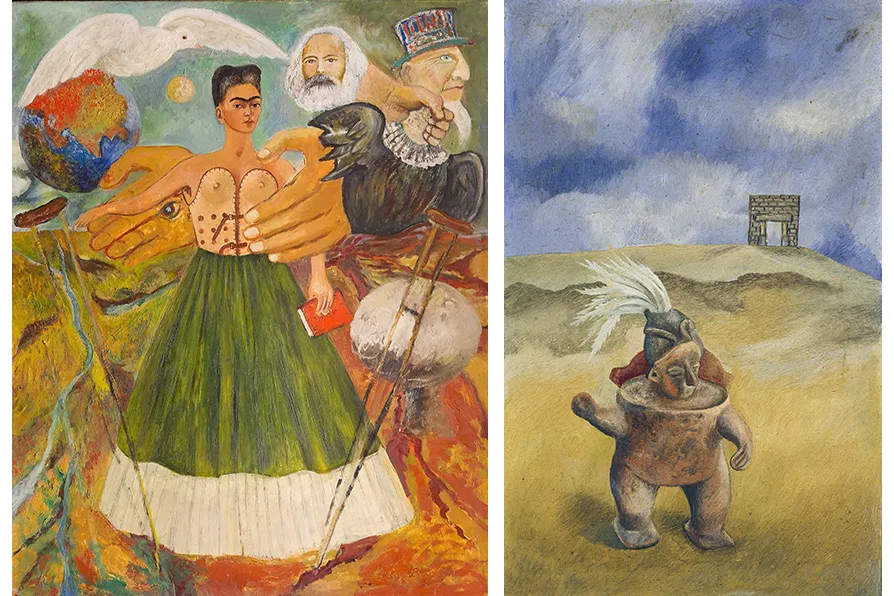
To rescue Kahlo from the clutches of the corporate art market, we need to acknowledge the overt and covert political dimensions of the work, demands GAVIN O’TOOLE


 Latest editorial
5G: Technology rules! But is that a good thing?
There seems to be no questioning the technological imperative both machinic and human, writes DENNIS BROE
 Still from Two or Three Things I Know About Her... directed by Jean-Luc Godard, 1967
If you can see past the relentless commodification you will be rewarded by enormously powerful work, suggests JENNY MITCHELL
CHRIS SEARLE revels in the one-off collaboration between an American polymath and a British Muslim, and detects the presence of their revolutionary forebear
GORDON PARSONS revels in an ebullient production of Shakespeare’s magical comedy
BRENT CUTLER welcomes a thoughtful analysis of the Erdogan regime, viewed through the evolving history of a neighbourhood in Istanbul
GORDON PARSONS regrets the price, but is dazzled by an outstandingly ambitious study of the way art restoration in particular, and culture in general was weaponised by the Nazis





5G will when it is fully operative increase download speeds such that general mobile phone internet activity will be 20 to 100 times faster, greatly enhancing watching Series TV on the go.
5G will also, its promoters claim, fulfil the promise of both artificial intelligence and the internet of things; of interconnected smart homes, smart cars and consumers served by smart farms and operated on by smart machines.
What could go wrong? Plenty, say 5G critics in France.
In the US and across Asia, in particularly in China and South Korea, the answer to what can go wrong is nothing.
In the US the “debate” over 5G is only on how fast and efficient the service is. The “criticism” is that the Verizon-Apple iPhone 12 and the AT&T-Galaxy 5G rollout, even in the large cities, is only partial, 4 times rather than 20 times faster.

Similar stories

DENNIS BROE observes how cutbacks, mergers and AI create content detached from both reality and history itself

As the Global Leaders’ Meeting on Women begins in Beijing, it’s clear that China has fulfilled its commitments set 30 years ago and delivered amazing progress in women's education and equality, writes YU BOKUN

Digital ID means the government could track anyone and then limit their speech, movements, finances — and it could get this all wrong, identifying the wrong people for the wrong reasons, as the numerous digital cockups so far demonstrate, warns DYLAN MURPHY

PAUL W FLEMING is unequivocal that Labour’s unpreparedness and resulting ambiguity on copyright in the creative industries has to be reined in with policies that will reverse the growing abuse by Big Tech AI