To rescue Kahlo from the clutches of the corporate art market, we need to acknowledge the overt and covert political dimensions of the work, demands GAVIN O’TOOLE


Error message
An error occurred while searching, try again later.Daylight robbery
LYNDA GRAHAM looks at how successive government allowed the water companies take us all for a ride
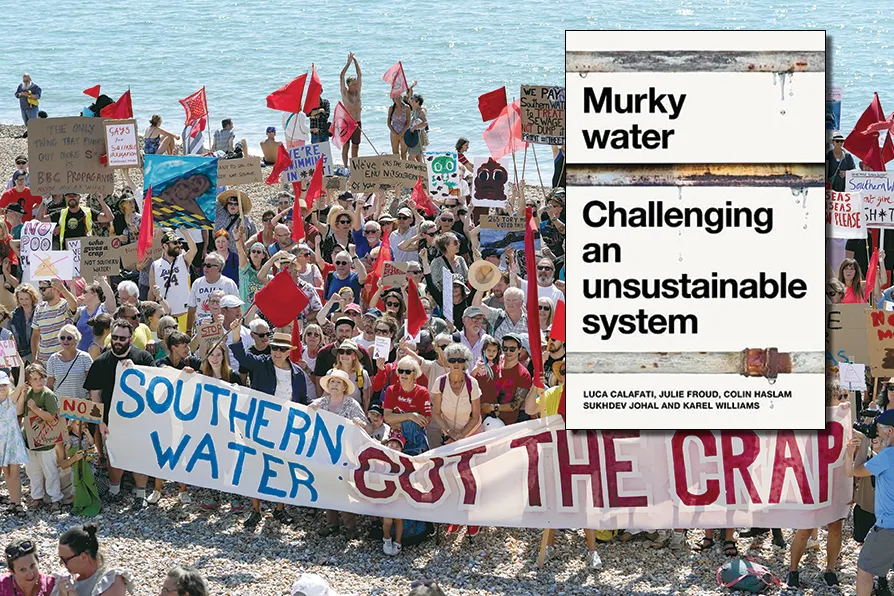
 LABOUR TURNS A DEAF EAR: Protest against raw sewage release on the beach in St Leonards, Sussex

If you can see past the relentless commodification you will be rewarded by enormously powerful work, suggests JENNY MITCHELL
CHRIS SEARLE revels in the one-off collaboration between an American polymath and a British Muslim, and detects the presence of their revolutionary forebear
GORDON PARSONS revels in an ebullient production of Shakespeare’s magical comedy
BRENT CUTLER welcomes a thoughtful analysis of the Erdogan regime, viewed through the evolving history of a neighbourhood in Istanbul
GORDON PARSONS regrets the price, but is dazzled by an outstandingly ambitious study of the way art restoration in particular, and culture in general was weaponised by the Nazis





Murky Water: Challenging an Unsustainable System
Luc Calafati, Julie Froud, Colin Haslam, Sukhdev Johal and Karel Williams
Manchester University Press, £14.99
MURKY WATER is a meticulously researched analysis of the state of the water industry in England and Wales, and outlines possible ways forward.
The introduction is arresting: “Murky (adjective): dark and dirty or difficult to see through; used to describe a situation that is complicated and unpleasant, and about which many facts are nor clear.”
The authors aim to “cut through the murk and reveal what is defective.” They begin by considering what they describe as the “stories” we currently tell ourselves about what has gone wrong. These are stories of financial extraction, failure of service and environmental challenge.
Financial extraction is a moral story about profits: water companies are privately owned in England and Wales, and profits go to the shareholders, not to investment in infrastructure.
Failure of service will be familiar to viewers of the recent three-part documentary on Channel 4, Dirty Business: stories of our polluted coastline and rivers, and of failure of water supply in specific areas.
Environmental challenge can no longer be ignored as we experience climate change across the globe, and requires long-term solutions that private owners and short-term government policies cannot provide.
In 1989, Margaret Thatcher privatised the water industry after writing off its debts and providing a huge green dowry which, as can have been predicted, was misused. The authors quote the Economist in this regard: “If you can privatise water, you can privatise anything”.
Thanks to Thatcher, we are the only country to have sold the stock and management of water — a vital resource and a basic human right, essential for life on the planet.
The researched detail of accounts of the 12 water companies in England and Wales pre- and post-privatisation are compelling, and the authors are to be applauded for this compelling evidence.
What to do is the burning question. So much has gone wrong, where to start?
The authors advocate “foundational water management”, by which they mean a water system that is:
• Technically capable in terms of sustained delivery of clean drinking water and disposal of waste water;
• Socially and spatially conclusive in terms of servicing all households in all regions;
• Financially accessible in terms of costs charged equitably so as not to overburden low-income households;
• Environmentally responsible, requiring water to be sourced sustainably, and waste disposed of in ways that are not environmentally damaging; and
• Democratic, with an informed public able to influence decision-making.
This is a compelling read for those who want to go beyond a simple call for renationalisation, to understand how we have reached the current appalling state of water management England and Wales, and to consider how we should proceed.
Recommended.
Lynda Graham is a member of the Croydon Morning Star Readers and Supporters Group