Andy Burnham’s growing stature has fuelled hopes of a Labour revival – but ALAN SIMPSON warns that Britain’s crisis runs far deeper than just its leadership and traces its roots to decades of financialised capitalism


 Latest editorial
Error message
An error occurred while searching, try again later.Cable Street’s real history must be told
Ninety years on from the famous anti-fascist victory, commemorations should acknowledge the central role played by Jewish workers and communist organisers in stopping Mosley’s march, says MARY DAVIS

Editor BEN CHACKO looks at the invaluable contribution the paper makes, and the headwinds it has to struggle against to get by, following the Morning Star’s 80th AGM this month
Recent violence in Belfast was not spontaneous — it was built on years of failure and political neglect, argues STIOFAN O NUALLAIN
The nationalisation move to Great British Railways (GBR) must be about more than just changing the livery, writes MARYAM ESLAMDOUST
Activists will urge MPs to protect the five-year settlement route and cut visa costs, warning reforms risk deepening inequality and labour shortages, says HARSEV BAINS
ANSELM ELDERGILL examines the issues of liberty, safety and risk in relation to people receiving psychiatric treatment





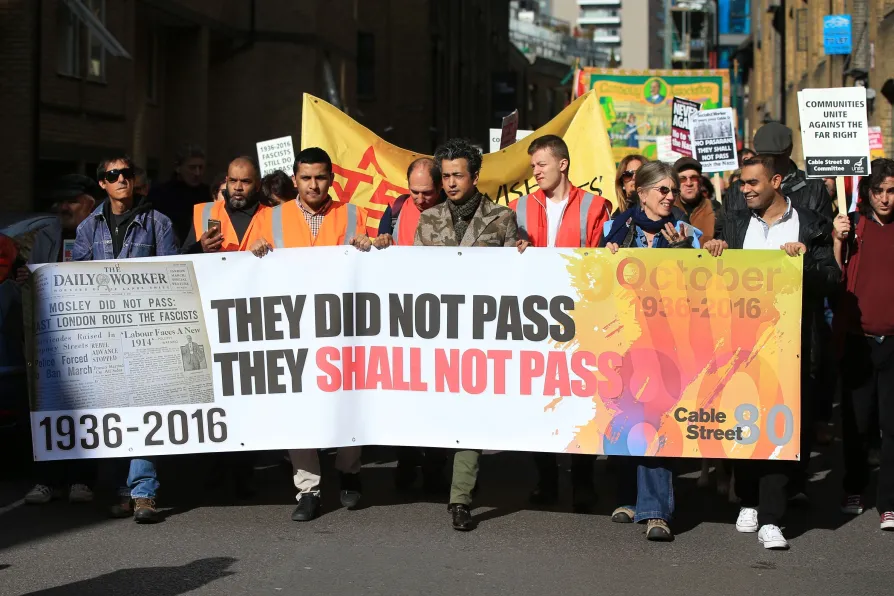
IT IS remarkable that the role of the Communist Party and the Jewish community continues to be overlooked by sections of the left in their eagerness to present Cable Street simply as an anti-racist victory led by vaguely defined “socialists.”
Regrettably, the Morning Star editorial of June 6 2026 repeats this historical inaccuracy.
Within the labour movement, the Communist Party stood at the forefront of the struggle against fascism in Britain.
Antisemitism was a defining feature of 20th-century fascism, a fact well understood by both communists and Jews.
Concentrated largely in London’s East End, Communist Party membership among Jewish people was disproportionately high relative to the size of Britain’s Jewish community, accounting for around a tenth of the party’s total membership.
Stepney alone had more than 1,000 party members in the 1930s. In 1947, the Stepney Communist Party Borough Committee reported that it had “the highest proportion of party members per capita in Great Britain — one member per 175 of population,” the majority of them Jewish.
From 1935, the British Union of Fascists (BUF) directed its antisemitic propaganda towards workers, urging them to blame Jews for economic hardship. It therefore concentrated its activity in working-class districts, especially the East End, home to a large proportion of Britain’s 330,000 Jews, who nonetheless made up only 0.8 per cent of the total national population.
The left always notes the aloofness of the Board of Deputies but fails to mention that the official Labour Party and trade union leadership played no part in anti-BUF activity; indeed, they actively discouraged it.
This position was enthusiastically endorsed by the Stepney Labour Party, which controlled the council and was itself influenced by the Catholic church, then deeply anti-communist and antisemitic.
In these circumstances, the Jewish community in the East End came to regard the Communist Party as the only effective defence against the BUF.
In Stepney, the party’s principal focus was to work through Jewish organisations such as the influential Workers Circle, the Jewish Cultural Club, and the East End branches of the furniture and tailoring unions, many of whose members were Yiddish speakers. Communists such as Mick Mindel were central to this trade union work — he was secretary of the Mantle and Costume branch of the National Union of Tailors and Garment Workers (NUTGW) and chairman of Stepney Trades Council.
The struggle against antisemitism and fascism was pursued on two fronts: directly through the establishment in 1936 of the Jewish People’s Council Against Fascism and Anti-Semitism, and indirectly, from 1937, through the Stepney Tenants Defence League.
Communists were both initiators and leading activists in these organisations. Jack Pearce served as secretary of the Jewish People’s Council, while Issie Pushkin, also a communist, edited its paper, Vigilance.
The Jewish People’s Council remains a model of a broad-front anti-fascist organisation. It brought together 86 Jewish organisations, including most East End synagogues, zionist groups, Workers Circles, trade unions and dockers.
This body, led by the Communist Party, organised the victory at Cable Street in 1936.
The tactics of the Communist Party, agreed after much internal debate, were two-fold. Firstly, the aim was to expose the fascist danger nationally and internationally and to ensure that it never gained a foothold in Britain, by mobilising entire communities to fight it on the streets.
This meant also fighting the police who saw their role as protectors of the fascists’ right to conduct their propaganda openly. Secondly the aim was, as Phil Piratin, (one of the communist leaders in the East End prominent in the anti-fascist struggle and later Communist MP for Mile End), put it “to cut the ground from under the fascists’ feet” (P Piratin, Our Flag Stays Red).
He and others argued that a distinction had to be made between the hard core of the BUF and the ordinary working-class people who were attracted to it. When the question was answered as to why such people were supporting Mosley, the party, having first dismissed such people as enemies, eventually drew the conclusion that:
“…there were certain latent anti-semitic prejudices…but above all these people, like most in east London, were living miserable, squalid lives. Their homes were slums, many were unemployed … therefore the Communist Party should help the people to improve their conditions of life, in the course of which we could show them who was really responsible … and get them organised to fight against their real exploiters.”
Thus the Communist Party decided to make housing a major focus of its work locally, linking it to the fight against fascism. This meant meticulous, slogging attention to local issues, especially the grievances of tenants against rack renting landlords and slum conditions and slowly but surely building an effective tenants’ organisation in Stepney in particular. The Stepney Tenants’ Defence League actually employed three full-time paid organisers.
It is impossible to assess the extent to which this kind of activity fulfilled the aim of winning away potential fascist sympathisers from the BUF. It is certain though that the prestige of the Communist Party was greatly enhanced.
Piratin was elected to Stepney Council in 1937 and by 1945 there were 12 Communist councillors, seven of whom were Jews, as well as a Communist MP — notably Piratin himself.
Reflecting on their successes, the Stepney Communist Party branch published a pamphlet in 1943, Stepney; A Borough to Be Proud Of. The pamphlet contained section on “Jew & Gentile Together” authored by Max Levitas (A Jew Writes) and Tommy Rampling (A Gentile Writes).
Levitas, an activist and organiser in all of the anti-fascist and housing campaigns initiated by the Stepney Party, wrote the following: “What is true for me is true for all Jewish workers. We Jews have the same enemies as our fellow citizens who are gentiles … It was in unity that we defeated Mosley in 1936. It was in unity as tenants that we won our victories over the landlords … Before and during this war bestial fascism has committed the foulest crimes … All progressive people have been its especial victims, but our people have been done to death merely because they were Jews … we must never forget that antisemitism and racial hatred existed before Hitler and fascism … All oppressors of the people have, when things grow difficult for them, diverted the just anger of the people by pogroms against Jews … such people are already at work. To defeat them we Jews must stand together, and we must maintain the unity of Jew and Gentile.”
As the 90th anniversary of the Battle of Cable Street approaches, historical accuracy matters. Any commemoration should clearly acknowledge two central facts: the Communist Party and the Jewish community played a decisive role in organising resistance, and the fight against antisemitism was the issue around which that movement was mobilised.