To rescue Kahlo from the clutches of the corporate art market, we need to acknowledge the overt and covert political dimensions of the work, demands GAVIN O’TOOLE


 Latest editorial
Error message
An error occurred while searching, try again later.Bringing Home the Ashes
At a tragic but farcical meeting at Heathrow Terminal 3, bigotry is concealed, sporting history is recalled, and a novelty wine bottle is creatively re-purposed. By John Hawkins
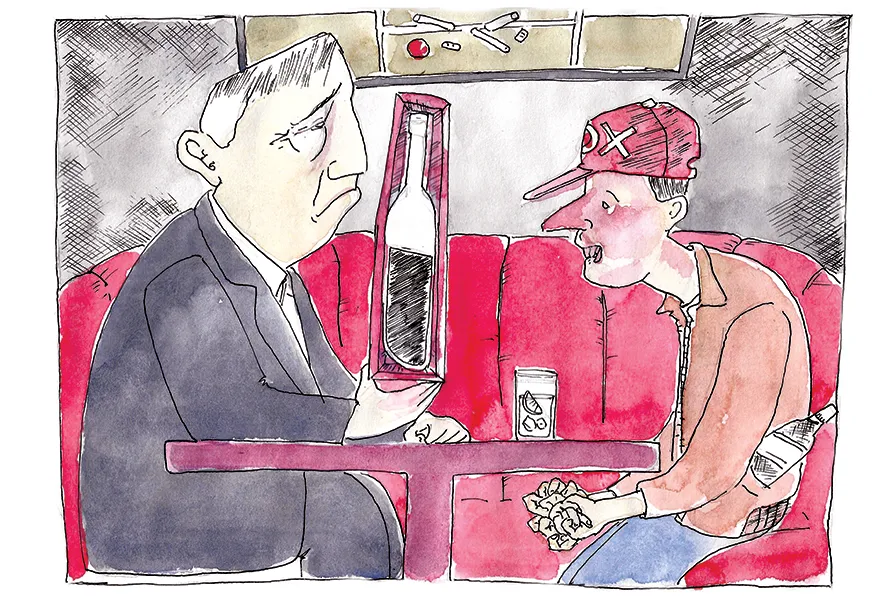 Illustration by Martin Gollan
If you can see past the relentless commodification you will be rewarded by enormously powerful work, suggests JENNY MITCHELL
CHRIS SEARLE revels in the one-off collaboration between an American polymath and a British Muslim, and detects the presence of their revolutionary forebear
GORDON PARSONS revels in an ebullient production of Shakespeare’s magical comedy
BRENT CUTLER welcomes a thoughtful analysis of the Erdogan regime, viewed through the evolving history of a neighbourhood in Istanbul
GORDON PARSONS regrets the price, but is dazzled by an outstandingly ambitious study of the way art restoration in particular, and culture in general was weaponised by the Nazis





IN an email exchange, Martin had agreed to meet Chris, the father of Bill Croft, on arrival at Heathrow, at a tavern in International Departures.
Martin wanted to fly in and fly out, handing Croft his son’s burnt remains, with a few rehearsed sentences of consolation for his loss, and without much explanation of what had happened in Abu Dhabi.
So, when he arrived at Heathrow he gave himself a couple of hours to go over his consolation speech, to hit the Duty Free, and to find a more appropriate burial container for Bill Croft’s ashes.
They had agreed to meet at the Darwin Pub in Terminal 3. Martin sat at the table looking out over the runway, re-reading his consolation blurb. It channelled Kevin Rudd’s “Sorry” speech to the Australian Aborigines for the tough luck of it all. An Aussie pal, back in Abu Dhabi, had shared it with him after Martin accused Aussie culture of being heartless to the Native Titlists.
In Duty Free he bought a 4.5 litre “party” bottle of Johnny Walker Black and found what he thought was a marvelous vessel to house the kid’s remains. It was a Hardys wine bottle in the shape of a cricket bat.
He poured the wine down the drain in the restroom. A handwashing Scot looked at him askance and muttered something he didn’t catch. When he made a funnel out of some thick paper and used the hand dryer to blow hot air into the bottle to evaporate the remaining liquid, the Scotsman said: “When the dram’s inside the sense is ootside. But ah see sobridee’s worse.”
Martin used the funnel to pour the ashes into the bottle. He placed the bottle back in the special display box with a glass cover it had come in. Martin was pleased at his own thoughtfulness.
It was cricket season and the Aussies were in town for the Ashes. That accounted for the coverage on TV, two blokes jawing about the “storied” history of the event.
Martin ordered a G&T with a twist of lemon and nursed it while he waited. He couldn’t really follow what the commentators were saying. His Aussie pal told him it was like baseball, so he developed a general concept of the game — ball, hit, run, score, most runs wins. But there was way more to it than that, his Aussie pal had told him. Martin just took him at his word, as he didn’t really give a shit, and didn’t want to suffer through a long yarn about conditions, silly points, and grinding out.
Then Bill’s Dad showed up.
He was a late middle-aged man, well-groomed, and quiet. Martin wrote that he would be wearing a Red Sox baseball cap and probably sitting by the windows. Chris looked flat as he approached, but he managed a small smile that soothed Martin’s nerves. He had been terrified that the Dad would pounce on him angry, demanding answers, maybe threatening to stick a bottle of Johnny Walker Black right up his arse.
But, no. He was a gentleman who sat quietly as Martin bought him a drink, and they both watched the cricket pre-game show.
“I’ve got to catch the next flight back to Abu Dhabi,” Martin began.
“But I did want to offer my deepest condolences for your loss. Bill was an excellent language teacher and his colleagues admired his methodology and tenacity. Some of the Arabs are thick as Jethro Tull’s bricks, if you know what I mean! And, um… ah, his colleagues had the highest regard for his character and work ethic. They said he will be missed.”
And with that Martin revealed the cricket-themed bottle with his kid’s ashes in it and added “We know how much he liked cricket, so…”.
“Thank you, Martin.”
Chris sat looking at the bottle.
Image
On the TV the commentators were going on about the origins of the Ashes. Back in 1882, blah blah blah, someone decided to light some bails on fire and place the ashes in a perfume bottle. Wouldn’t you know a woman was involved, thought Martin.
Blah blah blah, and they had jumped ahead to the 1930s, showing Don Bradman in his prime, routinely scoring “double centuries,” driving the English to foamy Maddogsvillle, with the commentators describing the rage and hatred for the colony of “convicts” who kept “sledging in the crease,” referring to the English cricketers as “Poms,” an esoteric insult only the cricketers seemed to understand.
When they’d had enough of the Aussies and Don Bradman, the English side came up with a way of bowling that aimed the ball on the bounce directly for the batter’s head, and called it “bodyline.” The Aussies shut their yap in the crease after that. When Martin saw the technique it reminded him of the Red Sox baseball star Tony Conigliaro getting smashed in the face with an errant pitch that dropped him and almost killed him.
Chris just sat there looking at the gift bottle.
Martin began to tense up, and fear that Chris might do the worst thing possible: ask him what happened to his son.
In his phone call of notification, and follow-up email to Chris, he’d been vague about details, saying the Emeratis wouldn’t give him all the information he’d “demanded from them to no avail” and had — horrifically — allowed his body to lay in an aluminium box on the tarmac in the sun for two days, while an argument among military types erupted over who should pay for the repatriation of his remains — the Emeratis or the Americans. Until someone suggested that his body be cremated in Dubai and the ashes placed in a container and delivered to relatives in England.
It was the cheapest option.
Like Martin, Bill had taught EFL at a military academy. But how could Martin explain that his son had been set upon upon by his fellow colleagues, EFL instructors with masters’ degrees in linguistics. Why? his father might ask. Because they coveted his coordinator’s position with its higher salary and longer contract, and took great interest in the fact that the programme director was a homophobe.
Rumours were spread about Bill’s profligate gay activities in Abu Dhabi. It was a black magic bullet that could get you killed. And by the time Bill caught on to the backstabbing doings of his colleagues, Emirati officers were beginning to threaten him. He endured the taunts. He began to drink heavily.
One morning another teacher offered up, with delight, his having witnessed an officer nearly running him over on the road as he crossed to an administration building. When he showed up at work in the morning reeking of alcohol, the Emeratis grew savage in their remarks (in Arabic) and his colleagues rubbed their hands. Until Bill just didn’t show up one morning.
He disappeared, it turned out, into a previously unknown underground gay community. Living nights here, nights there, among expats from the US, Sri Lanka, India, and from England. And unable to leave the country because his passport was in the possession of his employers, the military. After he’d been gone two months, the lead jackal of the conspiring group moved into Bill’s vacated office as the new co-ordinator.
Then one morning, word came that Bill’s bloated body had turned up and now needed to be dealt with.
Martin cringed when he thought about delivering such details. Followed by more questions, deepening anger, outrage, violent uncontrollability. What would he do? Here in a tavern at an airport in London? Chris had a right to be outraged. The thought of the police being called in to take this man away terrified him for its injustice.
What’s more, what if Chris asked him the name of the bastard who had taken Bill’s position, and he had to own up? That he was the man who had taunted his son to death?
Chris looked up from the bottle of ashes.
“You’ve got a plane to catch,” he said. “I won’t keep you. Thank you so much for bringing Bill home.” He touched Martin’s hands, gathered up the bottle, and walked away.
Martin blew a sigh of relief.
At the gate they confiscated his Duty Free Johnny Walker Black. You couldn’t take alcohol into Abu Dhabi, they said.
John Hawkins is a long-time freelance writer. He is currently pursuing a postgraduate degree in humanitarian action at the University of San Diego.
Stories, of up to 1,600 words, should be submitted to: Morningstarshortstories@gmail.com